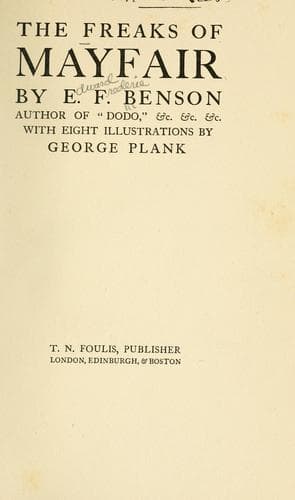
The Freaks of MayfairBenson, E. F. (Edward Frederic)
General
The Freaks of Mayfair
Benson, E. F. (Edward Frederic)
England -- Social life and customs -- 20th century -- Fiction; Humorous stories, English; Short stories, English
But it is to be feared that even at this early age of thirty-four he is
a hopeless case. His engagement book is filled to repletion, and he
lunches and dines every day with pleasant acquaintances, and during the
slack months of London stays with them in their pleasant houses. He
makes ‘rounds’ of visits; all August and September, all January and all
April he is in the country, quartered on people whom he does not care
about, and who do not care about him. But he is always so pleasant; he
always knows everybody, and when the men come out of the dining-room in
the evening he always sinks into a chair beside a rather unattractive
female, and converses quite amusingly to her till he is summoned to the
bridge table. Then he always says he is being ‘torn away,’ and promises
to tell her the rest of it to-morrow morning. And the bereaved lady
thinks what a nice man Mr. Bashton is. And so he is.
But as years go on he will get a little lazier and a little stouter.
Gradually he will be relegated to the second line, and the young piping
bullfinches who succeed him will in the chirpiness of their early songs
wonder why that ‘old buffer’ still assumes the airs of youth. He will
still appear in the smoking-room with the stories that were once of
contemporaneous happenings, and now seem to the young birds tales of
ancient history. By degrees his country visits will dwindle, for
country-houses are so draughty, and he will sit and snooze in his club,
presenting the back of an odious bald head to the passer-by in St.
James’s Street, as he waits for the familiar crowd to return to London
again after the Christmas holidays. His contemporaries will have tall
sons and daughters growing up round them, and he will be familiarly
known as Uncle Leonard, and yet all the time he will think he is
something of a gay young spark yet, and point out Lady Birmingham’s
daughter and Mrs. Cyrus Plush’s son to his neighbour at the opera.
Then some day, if fate is kind, he will have a fit and die without more
ado. Not a single person in the world will really miss him, for the very
simple reason that there was nobody really there. He will have touched
no heart, he will have nothing and have produced nothing but the little
songs and bows that young bullfinches perform with so much more verve.
Somebody at the club when he no longer takes a sheaf of newspapers under
his arm will say, ‘Poor old Bashton: nice old chap! Getting awfully
doddery, wasn’t he? Are you going to see the new play to-night?
Haymarket, isn’t it?’
CHAPTER TWELVE
THE PRAISERS OF PAST TIME
Public-domain text, read in full here on John Shaqi.
Reviews
Reviews
No reviews yet
Be the first to share your thoughts on this work.
Elsewhere in the archive
Join the Discussion
Join the discussion
Sign in to leave a comment or review.
Sign InorCreate an account