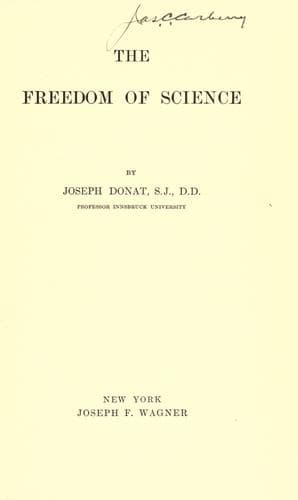
Free thought; Modernism (Christian theology) -- Catholic Church; Religion and science; Teaching, Freedom of
On the other hand, it is a poor science that has nothing to offer but an
eternal query for the truth. A poor science, that with self-consciousness
promises enlightenment and what not, but finally can give nothing but
ceaseless doubt instead of truth, tormenting darkness instead of cheerful
light. Why, then, research where nothing can be found? Why raise searching
eyes to the sky when the stars do not show themselves? What kind of
progress is this when science does nothing further than dig forever at the
foundation? The great _St. Augustine_ has long also passed judgment on
this kind of science: “Such doubting is abhorred by the City of God as
false wisdom, because among the things which we grasp with our intellect
and reason there is a knowledge, limited, it is true, because the soul is
weighed down by a perishable body, as the Apostle says: _ex parte
scimus_—but which has full certainty” (De Civitate Dei, XIX, 18).
An Erroneous Supposition.
The errors just dealt with, and the demand that scientific research must
doubt everything, is based on a supposition often stated expressly as a
principle, and which appears quite plausible even to a mind not trained in
philosophy. It says: There is but one certainty, the scientific certainty;
the certain possession of the truth can be obtained only by scientific
research. To rid the world of error, we are told, “there is but one way,
viz., scientific work. Only science and scientific truth are able to
dispose of error” (_Th. Lipps_, Allgemeine Zeitung, Muenchen, August 4,
1908). “Truth is scientific truth, based on criticism, hence the religion
of modern man must also rest on critical truth.... There is no other
authority but science” (_Masaryk_, Kampf um die Religion, 13).
This sort of speech we hear from the college chair as the slogan for
education and enlightenment: any one deficient in science or in education
belongs more or less to the unthinking mass who have no convictions of
their own, but submit blindly to impressions and authority.
Public-domain text, read in full here on John Shaqi.
Reviews
Reviews
No reviews yet
Be the first to share your thoughts on this work.
Elsewhere in the archive
Join the Discussion
Join the discussion
Sign in to leave a comment or review.
Sign InorCreate an account