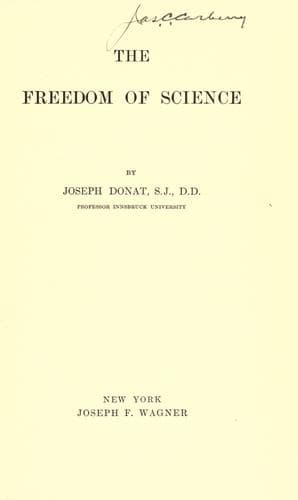
Free thought; Modernism (Christian theology) -- Catholic Church; Religion and science; Teaching, Freedom of
Such unclarified conceptions, with their inferences, are even met
with where they would not be expected, for instance, we read:
“What the average individual needed was a good shepherd, a
shepherd’s devotion and love, that uplifts and urges onward; it
was authority, Church-ministry and care of souls, that was needed.
The Church is an organized pastorate, for the average individual
likes to go with the flock. The chosen are they who feel within
themselves the great question of truth as the care of their heart
and task of their life, who experience its tremendous tension, and
who are struggling to the end with the intellectual battles
provoked by this question of truth. The average people, _i.e._,
the many, the great majority, need something steady to which they
can cling—persons and teachers, laws and practice.” And why this
uncharitable distinction between people belonging to the flock and
the chosen ones, as if the Church and its ecclesiastical functions
were only appointed for the former? Particularly because “without
methodical scientific work man cannot attain to the truth” (_H.
Schell_, Christus, 1900, 125, 64).
Thus science may summon everything before its forum, no one having a right
to interfere; in the superiority bestowed by the right of autocracy it may
sweep aside everything that is opposed to it, no matter by what authority.
Hence science must be free to jolt everything, free to question the truth
of everything, which it has not itself examined and approved. This is the
fundamental supposition of modern freedom of science; also a fatal error,
betraying a woeful ignorance of the construction of the human intellect,
in spite of all its pretentiousness. As a rule we have a true certainty in
most matters, particularly in philosophical-religious convictions, a
certainty not gained by scientific studies; by aid of the latter we may
explain or strengthen that certainty, but we are not free to upset it.
We cannot avoid examining this point a little closer. There is a twofold
certainty, one, which we shall call the _natural_ certainty, is a firm
conviction based on positive knowledge, but without a clear reflexive
consciousness of the grounds on which the conviction is actually resting.
Reason recognizes these grounds, but the recognition is not distinct
enough for reason to become conscious of them, to be able to state them
accurately and in scientific formulas. _scientific_ certainty is a firm
conviction, with a clear consciousness of the grounds, hence it can easily
account for them. Natural certainty is the usual one in human life;
scientific certainty is the privilege of but a few, and even they have it
in but very few things.
Public-domain text, read in full here on John Shaqi.
Reviews
Reviews
No reviews yet
Be the first to share your thoughts on this work.
Elsewhere in the archive
Join the Discussion
Join the discussion
Sign in to leave a comment or review.
Sign InorCreate an account