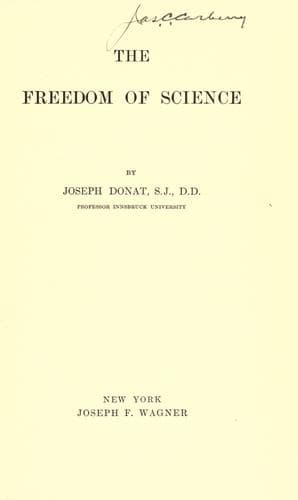
Free thought; Modernism (Christian theology) -- Catholic Church; Religion and science; Teaching, Freedom of
Everybody has a positive intellectual certainty that a complicated
order cannot be the result of accident, and that for every event
there must be a cause, though not every one will be able readily
to demonstrate the truth of his certainty. But if the philosopher
should look for the proof, he would do so in no other way than by
reflecting upon his natural and direct knowledge, and by trying to
become conscious of what he has thus directly found out. To
illustrate by a few examples: We are all convinced of the
existence of an exterior world, and any one who is not an idealist
will call this conviction a reasonable certainty, and yet only a
few will be able to answer the subtle questions of a sceptic. This
certainty again is a natural but not a scientific one. How
difficult it is here also for reason to attain scientific
certainty, how easy it is to go astray in these researches, is
proved by the errors of idealism so incomprehensible to the
untrained natural mind. Let us ask, finally, any one: Why must we
say: “_Cæsar_ defeated _Pompey_,” but not “_Cæsar_ defeated of
_Pompey_”? He will tell us this is nonsense; maybe he will add
that the genitive has another meaning. But should I ask further
how the meaning of the genitive differs from that of the
accusative, as both cases seem to have often the same meaning, I
shall get no answer. There is a certitude, but only a natural one.
Even if I should ask modern students of the psychology and history
of languages, like _Wundt_, _Paul_, or whatever their names may
be, I should not get a satisfactory answer either. The whole logic
of language, with its subtle forms and moods of expression—how
difficult for scientific research! And yet the mind of even a
child penetrates it, and not only a European child, but the
Patagonian and negro child, who is able to master by its
intellectual power complex languages, with four numbers, many
moods, fourteen tenses, etc.
Public-domain text, read in full here on John Shaqi.
Reviews
Reviews
No reviews yet
Be the first to share your thoughts on this work.
Elsewhere in the archive
Join the Discussion
Join the discussion
Sign in to leave a comment or review.
Sign InorCreate an account