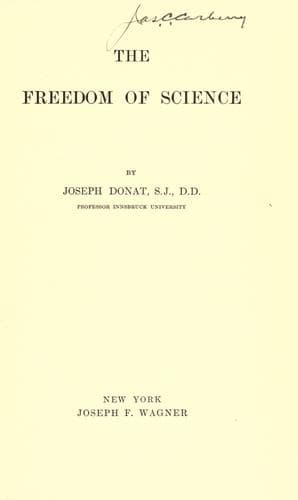
Free thought; Modernism (Christian theology) -- Catholic Church; Religion and science; Teaching, Freedom of
This evidence is seen in the invincible stability of the Church
and its unity of faith, the incontestable miracles never ceasing
within it, the grand figures of its Saints and Martyrs, virtue in
the various classes, a virtue increasing in proportion to the
influence the Church exerts, the spectacle that everything truly
noble is attracted by the Christian faith and the contrary
repulsed. In addition the intrinsic grandeur and harmony of the
truths of faith, above all the unique figure of Christ, with His
wonderful life and sufferings, also the calm and peace of mind
effected in the soul of the faithful by living and thinking in
this faith; all these tell him that here the spirit of God is
breathing, the spirit of truth. The natural light of his
intellect, further illuminated by grace, suffices to give him a
true intellectual certainty of his faith, based upon these motives
and similar ones, even without scientific studies. The calmness of
the mind that holds fast to this faith, the compunction and unrest
which follow defection from the faith, both so characteristic of
Catholics, prove that their minds embrace the truth in their
faith.
Hence it betrays little philosophical knowledge of the peculiarity
of man’s intellectual life, if infidelity approaches an
inexperienced, believing student, perhaps even an uneducated
labourer, with the express assurance that his faith hitherto has
been but a blind belief, an unintelligent following of the lead of
a foreign authority, with the distinct admonition to turn his back
on the faith of his childhood.
What has been said above makes it clear why a Catholic is not
permitted to have a serious doubt about his faith under the
pretext that he ought first to form a certain conviction all for
himself by scientific investigation. He has it already, if we
presuppose sufficient instruction and normal conditions; he may
raise his natural certitude to a scientific one by study if he has
the time and talent for it, but he must not condition his assent
upon the success of his scientific investigations. He has
certitude; he has no right to demand scientific knowledge as a
necessary condition, because it is not required for certitude, and
also because it lies altogether outside of the conditions of human
life. It would amount simply to shaking off the yoke of truth. The
Church teaches as follows: “If any one says that the condition of
the faithful and of those who have not yet come to the only true
faith is equal, so that Catholics can have a just cause for
suspending their assent and calling in question the faith which
they have received by the ministry of the Church until they have
completed the scientific demonstration of the credibility and
truth of it, let him be anathema.”
Public-domain text, read in full here on John Shaqi.
Reviews
Reviews
No reviews yet
Be the first to share your thoughts on this work.
Elsewhere in the archive
Join the Discussion
Join the discussion
Sign in to leave a comment or review.
Sign InorCreate an account