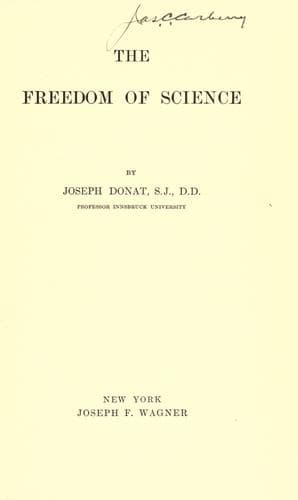
Free thought; Modernism (Christian theology) -- Catholic Church; Religion and science; Teaching, Freedom of
How high this wisdom rises above the limited thought of a science that
imagines itself alone to be wise! Sad indeed would be the lot of mankind
could it attain to certain truth in the most important questions of life
only by lengthy scientific investigations. The overwhelming majority of
mankind would be forever excluded from the certain knowledge that there is
a God, an eternity, liberty, that there are immutable moral laws and
truths, on the value of which depends the woe and weal of humanity.
Behold the wisdom of the world that is put before us: “In order to
arrive at a definite conclusion by our own philosophical reasoning
(on the existence of God and the possibility of miracles) what a
multitude of things must be presupposed!” Thus we are informed in
a philosophical novel of modern times which aims at proving the
incompatibility of the Catholic duty to believe with the freedom
of the intellect [Katholische Studenten, by _A. Friedwald_ (nom de
plume). An explanation of the ideas contained in it is given by
the Academia 18, 1905-6, December and March. The ideas found in
the novel are also advanced by _A. Messer_, Einführung in die
Erkenntnistheorie, 1909, p. 158 _seq._]. And Prof. _Rhodius_, who
put the ideas of the novel in formulas, teaches: “The question
whether our knowledge could penetrate beyond what we know by our
experience and even our senses, is answered, as you know, in the
negative by a noted philosophical school. Hence, before attacking
those metaphysical questions regarding the existence of God and
His relations to the world, we must first try to have definite
views as to the essence of human knowledge, of its criterion, its
scope, and of the degrees of its certainty. But these preliminary
questions of theoretic knowledge, how difficult and perplexing
they are! You probably have not the faintest idea into what a mass
of individual problems the main questions must be dissected, nor
what a multitude of heterogeneous views are struggling here
against one another” (p. 181).
Public-domain text, read in full here on John Shaqi.
Reviews
Reviews
No reviews yet
Be the first to share your thoughts on this work.
Elsewhere in the archive
Join the Discussion
Join the discussion
Sign in to leave a comment or review.
Sign InorCreate an account