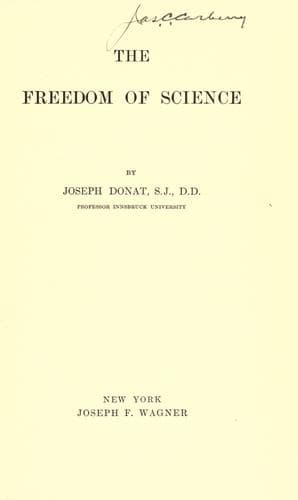
Free thought; Modernism (Christian theology) -- Catholic Church; Religion and science; Teaching, Freedom of
Consider how shortsighted a wisdom is manifested by these words.
Is it seriously intended to summon the peasant from his plough,
the old grandmother from behind the stove, and lead them into the
lecture rooms of the university in order that they might there
listen to lectures on phenomenalism, and positivism, and realism,
and criticism, until their heads are swimming? Or else can they
not hope to arrive at the truth? Do they seriously think that the
truth asked for by every man, the truth in the most vital
questions of mankind, is the exclusive privilege of a few college
professors? And how very few. More than twenty-four hundred years
have elapsed since the days of _Pythagoras_, and yet modern
philosophy still stands before the first preliminary question in
all knowledge, whether a man can know what the eye does not see.
“Many views are at variance there.” If this be the only way for
mankind to reach certain truth, then we are indeed in a pitiful
plight!
We esteem philosophy and its subtle questions, and we heartily
wish our Catholic young men in college to obtain a more thorough
philosophical training. But if, involved in theories, one will
lose his insight into the world and human life to such a degree as
to make of the “wisdom of the world” an isolated narrow
speculation which boasts of being alone able to discover the
higher truths, while withering in neurasthenic doubt—such wisdom
should be left to its deserved fate, sterility.
Or should it be possible to the ideal of Protestantism—and
therefore also of the modern spirit—to console mankind by pointing
out that the knowledge of the question which concerns us most
deeply, “the knowledge of God and the knowledge of good, remains
but a leading idea and problem, though we are confident of
advancing nearer to its solution”? Is thus mankind to be eternally
without light in the most important questions and problems? Every
little plant and animal is equipped by nature with everything it
needs—and man alone to be a failure? The young shoots of the tree
strive to bring forth blossoms and fruit, and succeed; the bird
flies off in the fall in quest of a new home, and finds it; hunger
and thirst demand food and get it; only the aim of the human mind
shall never be fulfilled—he alone shall ever pine without
hope!—_Dicentes se esse sapientes stulti facti sunt._ What a
difference between such principles and the grand thoughts of
Christianity! A difference like that between peace and eternal
restless doubt, like that between man’s dignity and man’s
degradation, between man’s short-sightedness and the wisdom of
God.
Public-domain text, read in full here on John Shaqi.
Reviews
Reviews
No reviews yet
Be the first to share your thoughts on this work.
Elsewhere in the archive
Join the Discussion
Join the discussion
Sign in to leave a comment or review.
Sign InorCreate an account