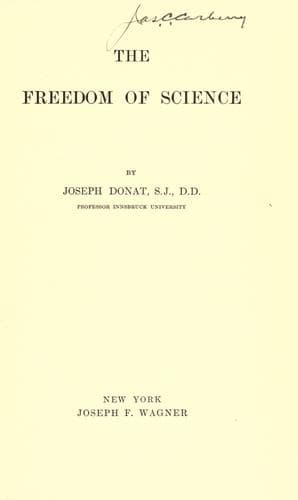
Free thought; Modernism (Christian theology) -- Catholic Church; Religion and science; Teaching, Freedom of
Prior to the Reformation, universities were not state institutions, as
they are at present in Europe, but free, independent corporations. They
were complete in themselves, they made their own statutes, had their own
jurisdiction, and many other privileges. The modern university enjoys but
a small remnant of those ancient prerogatives. In a public speech, made in
the presence of the Duke of Saxony, the Leipsic professor, _Johann Kone_,
could say in 1445: “No king, no chancellor, has any right to interfere
with our privileges and exemptions; the university rules itself, and
changes and improves its statutes according to its needs” (_Janssen_, 1.
c. 91).
Up to the year 1300 there were no less than 23 universities established in
Italy, 5 in France, 2 in England, 4 in Spain, and 1 in Portugal. “Had all
intentions been realized, Europe would have had by the year 1400 no fewer
than 55 universities, including Paris and Bologna. But of 9 of them there
are extant only the charter deeds that were never executed. At any rate,
there were 46 of them, of which 37 or 39 existed at the turn of the
fourteenth century; a considerable number, which was not known till recent
years” (_Denifle_). Germany, Austria, and Hungary shared in 8: Prague,
Cracow, Vienna, Fuenfkirchen, Ofen, Heidelberg, Cologne, and Erfurt.
Within fifty years, from 1460 to 1510, no less than 9 universities were
founded in Germany—a clear proof of the generous enthusiasm for science of
that period.
By their fostering and founding of universities, secular princes have won
the lasting gratitude of posterity, and so have the municipalities of a
later period for showing an even greater zeal than those princes. But it
was indisputably the Church that bestowed upon these homes of learning and
culture the greatest benevolence and support for their foundation and
maintenance.
Public-domain text, read in full here on John Shaqi.
Reviews
Reviews
No reviews yet
Be the first to share your thoughts on this work.
Elsewhere in the archive
Join the Discussion
Join the discussion
Sign in to leave a comment or review.
Sign InorCreate an account