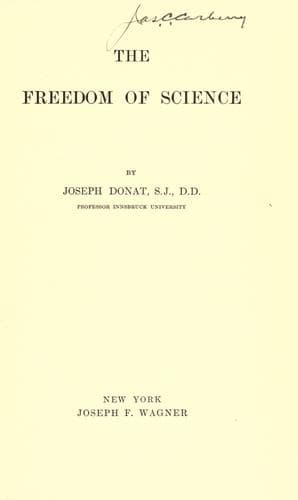
Free thought; Modernism (Christian theology) -- Catholic Church; Religion and science; Teaching, Freedom of
In the first place, history shows that the majority of them were founded
by _Papal charters_. Since universities were understood to have the power
of conferring degrees of international value, they had to be universally
acknowledged; this could be effected only by an authority of universal
recognition; hence by the Roman-German Emperor—as the supreme prince of
the world-wide Christian monarchy, or by the Pope, who was considered in
the first place. He was the general Father and Teacher of Christendom;
this is why Papal charters were so zealously sought after, in addition to
imperial charters. Of the 44 universities called into existence before the
year 1400, 31 were founded by Papal charters. A similar condition
prevailed in the fifteenth century and afterwards, up to the Reformation.
This was no interference in foreign affairs: such an interpretation would
have caused just surprise in the Middle Ages. That the highest spiritual
power on earth should have the first claim in education was a matter of
general concession. And certainly the manner in which the Church made use
of this right, to speak with an historian of the universities, forms “one
of the most important, and by no means least inglorious, parts of an
activity so manifold and difficult” (_V. A. Huber_, Die Englischen
Universitaeten, I, 1839, p. 14).
These Papal charters breathe a warm _benevolence_ for science. Everywhere
we find the wish expressed, that studies thrive in those places which are
most suitable for the effectual spread of science, and that the different
countries have a sufficient number of scientifically trained men.
Public-domain text, read in full here on John Shaqi.
Reviews
Reviews
No reviews yet
Be the first to share your thoughts on this work.
Elsewhere in the archive
Join the Discussion
Join the discussion
Sign in to leave a comment or review.
Sign InorCreate an account