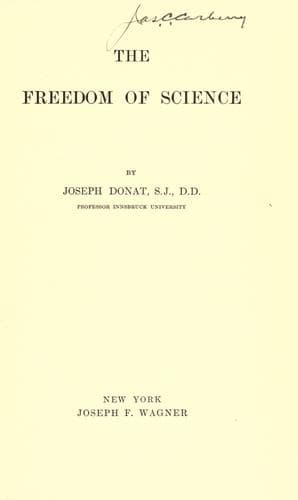
Free thought; Modernism (Christian theology) -- Catholic Church; Religion and science; Teaching, Freedom of
One consequence of this relation between the universities and the Church
was that “they attained their greatest prosperity as long as the unity of
Church and faith remained unimpaired, and that, at the time of the
Reformation, they all sided with the Church with the exception of two,
Wittenberg and Erfurt. Torn away from their ecclesiastical and established
basis only by violent means, they were led to the new doctrine, but really
succumbed to it only when their freedom had been curtailed and they had
been reduced to state institutions” (_Janssen_, l. c. p. 91). They had
been, as the learned _Wimpheling_ wrote at the close of the sixteenth
century, “the most favoured daughters of the Church, who tried to repay by
fidelity and attachment what they owed to their Mother” (De arte
impressoria, apud _Janssen_, l. c. 91).
A False Progress.
Hence history cannot subscribe to the accusation that the Church is the
enemy of progress. How then does it happen that this accusation is made so
frequently? The idea suggests itself that there may be here a different
meaning given to the word “progress,” that the Church opposes a certain
kind of progress which her enemies call “the” progress. And this is the
actual fact. If we examine the proofs which are to show the hostile
attitude of the Church, we meet at every step _Galileo_, the Copernican
system, the Syllabus, and Index. But this appears only on the surface,
which hides beneath it something that is easily overlooked by the cursory
glance. And this is the precise definition of scientific and civilized
progress. Progress has ever been an ideal of powerful attraction. The
noblest and best of men have ever displayed the most earnest endeavour
onward and upward. In our times, however, this ideal comes forward
differently garbed, in the name of the new view of the world, and
resolutely censures as reactionary everything that will oppose it. What is
this definition?
Since the _theory of evolution_ of _Lamarck_ and _Darwin_ entered biology,
it has also more and more invaded other branches of science. The principle
is now that everywhere, in the organic or inorganic world and in the whole
province of human life there is a gradual growth and change—nothing
permanent, nothing definite and absolute. Uninterrupted evolution
hitherto; hereafter restless development; especially in the greatest good
belonging to human life, thought, philosophy, and chiefly religion. Here,
too, there are no forms nor dogmas which evolution in its continual
development does not evolve and elevate. This idea of evolution is
supplemented by subjectivism with its _relativism of truth_: all views,
especially philosophical and religious “Truths,” are no longer the
reproduction of objectively existing things, but a creation of the
subject, of his inner experience and feeling; hence each age must proceed
to new thought of _its own_.
Public-domain text, read in full here on John Shaqi.
Reviews
Reviews
No reviews yet
Be the first to share your thoughts on this work.
Elsewhere in the archive
Join the Discussion
Join the discussion
Sign in to leave a comment or review.
Sign InorCreate an account