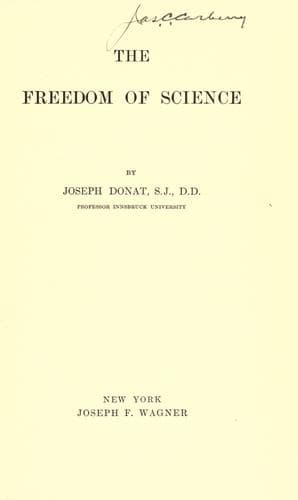
Free thought; Modernism (Christian theology) -- Catholic Church; Religion and science; Teaching, Freedom of
“The methods of scientific research,” we are told, “are determined
by the idea of evolution, and this applies not only to natural
sciences but also to the so-called intellectual sciences,—history,
philology, philosophy, and theology. The idea of evolution
influences and dominates all our thoughts; without it progress in
the field of scientific knowledge is quite impossible.” We read,
for instance, in the modern history of philosophy: “The rise and
fall of a system is a necessary part of universal history; it is
conditioned by the character of its time, the system being the
understanding of that time, while this understanding of the time
is conditioned by the fact that the time has changed.” At
_Roscellin’s_ time the nominalists were intellectually inferior;
but where there is question of undermining the militant Church of
the Middle Ages the nominalists will be considered to have been
the greater philosophers. In this the realists “by the futility of
their struggle proved that the time for nominalism had arrived,
hence that whoever favours it understands the time better; that
is, more philosophically. After the beginning of the Renaissance
we notice an attempt at philosophizing in such a way as to ignore
the existence of divine wisdom taught by Christianity. The
pre-Christian sages had done so: to philosophize in their spirit
was therefore the task of the time, and those who had a better
understanding of the time philosophized that way better than by
the scholastic method; though their method may appear reactionary
to unphilosophical minds” (_J. E. Erdmann_, Grundriss der Gesch.
der Philosophie, 3d ed., I (1878), 4, 262, 434, 502). This is a
frank denial of any truth in philosophy: the more neological and
modern a thing is, the more truth there is in it! Realism was
right in _Roscellin’s_ time, but a later period had to sweep it
away. The Christian religion was right for the Middle Ages, but
when the Greek authors began to be read again it was no longer
modern.
Apostasy from the faith is considered a mark of progress. “Italian
natural philosophy,” we are told, “reached its pinnacle with
_Bruno_ and _Campanella_, of whom the former, though the older,
appears to be more progressive on account of his freer attitude
towards the Church” (_R. Falkenburg_, Gesch. der neueren
Philosophie, 5th ed. (1905), page 30, _seq._). Hence evidently
further development of Christianity, too, is demanded. According
to subjectivistic views it was hitherto only an historical product
of the human intellect: hence “onward to new and higher forms
corresponding to modern thought and feeling, onward to a new
Christianity without dogmas and authority!” “Break up those old
tablets,” spoke _Zarathustra_.
Public-domain text, read in full here on John Shaqi.
Reviews
Reviews
No reviews yet
Be the first to share your thoughts on this work.
Elsewhere in the archive
Join the Discussion
Join the discussion
Sign in to leave a comment or review.
Sign InorCreate an account