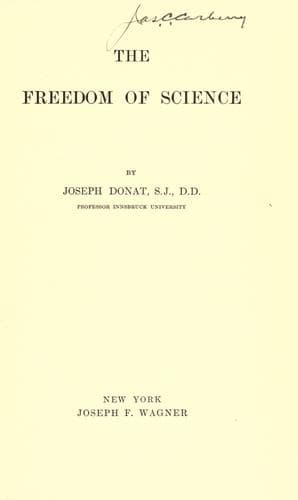
Free thought; Modernism (Christian theology) -- Catholic Church; Religion and science; Teaching, Freedom of
It has changed the position of man. It has forgotten that man is a
created, limited, even a fallen being, withal destined for eternal
existence. To it man is everything; man left to himself and to his life in
this world, severed from God and his eternal destiny, an _absolute, purely
worldly being_. No longer does he look up to Heaven, no longer does he get
from above his laws, his hope for help, and strength, and eternal life. He
is his own and only end: he and his earthly happiness and advancement. In
himself alone he sees the source of his strength, in himself he finds his
law, to himself alone is he responsible, the inherited corruption of his
nature he has forgotten. What God once was to our fathers—the end and rule
of their life—that now is Man to their sons. The anthropocentric has
succeeded the theocentric view of the world. _Diis extinctis successit
humanitas_ (Man has succeeded the fallen gods). “Out of the corrupted
nations and decaying religions let there arise a more beautiful humanity!”
is the radical cry of this humanitarian religion.
When in 1892 the battle for a new school law was raging in Prussia,
_Caprivi_, the Chancellor of the Empire, said: “It is here question of a
contrast between Christianity and atheism. Essential to man is his
relation to God.” Scarcely had these words been uttered when a champion of
modern thought, Prof. _Fr. Jodl_, took up his pen and wrote: “No sharper
contrast with the convictions of the modern world is imaginable than that
expressed by the words of the imperial Chancellor, ‘essential to man is
his relation to God.’ To this sentence, which might be expected in a
speech of Cromwell, or in a papal encyclical, rather than from a statesman
of modern Germany, liberalism must with all possible emphasis oppose this
other sentence: What determines the real worth of a man, is, first and
last, his relation to humanity” (Moral, Religion und Schule, 1892, 14f.).
_Diis extinctis successit humanitas_. We shall not deny that the modern
spirit is a complicated structure: but neither can any one deny that its
chief characteristic is the humanitarian view, with its emancipation from
God, its decided emphasis of the things of this world, and its boundless
overestimation of man.
An attentive observer of these days, should he chance to come from an old,
Catholic town, and saunter with observant eye through one of our great
modern cities, particularly a Protestant one, would behold a vivid
realization of this modern view of the world. The most prominent feature
of the Catholic town of old was the House of God. It towered high above
the city, its spires reached heavenward; the houses of the faithful clung
around the House of God like chicks about the mother hen. The mere sight
told the beholder that here dwelt a people whose thoughts were directed
towards the other world; over their lives ruled the sacred peace of
eternity.
Public-domain text, read in full here on John Shaqi.
Reviews
Reviews
No reviews yet
Be the first to share your thoughts on this work.
Join the Discussion
Join the discussion
Sign in to leave a comment or review.
Sign InorCreate an account