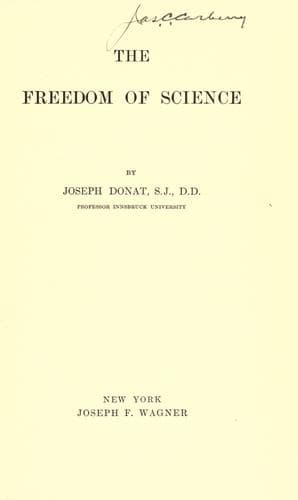
Free thought; Modernism (Christian theology) -- Catholic Church; Religion and science; Teaching, Freedom of
How the Prussian censorship proceeded in those days may be
illustrated by another example. “At the time of the Vatican
Council a publisher, _Joseph Bachem_, came to Dr. _Westhoff_,
rector of the Seminary of Cologne, a man of venerable years, and
told him of his misgivings about the dogma of the infallibility.
In his youth he had been taught the maxim that that is Catholic
which has been taught always, everywhere, and by everybody; yet he
had until recently never found the doctrine of Papal Infallibility
taught, neither in schools nor in text-books. Then the reverend
old rector took the visitor by the hand and led him into the
library of the seminary, where he showed him not less than sixteen
catechisms that had been in use in the Archdiocese of Cologne
during the eighteenth century, and which stated without exception,
clearly and convincingly, the doctrine of Papal Infallibility in
matters of faith and morals. The publisher in utter astonishment
then asked how it was that this doctrine was not taught in later
editions. Dr. _Westhoff_ referred him to the Prussian censure,
enforced until 1848, which had expunged this doctrine from all
Catholic catechisms. From that moment _Bachem_ no longer wavered
in his opinions” (Koelnische Volkszeitung, September 7, 1893).
One may also remember _Bismarck’s_ press-campaign during the
_Kulturkampf_. Professor _Friedberg_, Prussian court canonist,
instigated this campaign, and in many ways devised the plan of
attack. This much-praised liberalism—how tyrannically it proceeded
against the Catholic press! The Frankfurter Zeitung in those days
took a census of convictions due to the press law. According to
the census, which “does not by far claim to be complete,” there
were of newspaper editors sentenced in 1875—21 in January, 35 in
February, 29 in March, 24 in April; in four months 137 newspaper
writers were either fined or sent to jail. During the same period
30 newspapers were confiscated (Staatslexikon, IV, 550). This is
not all. “We could mention at least three instances,” says _P.
Majunke_ in his History of the Kulturkampf, “where agents of the
Berlin secret police have succeeded in obtaining a position on the
editorial staff of Catholic papers, staying for a year or more.
Besides serving as spies these fellows had to perform the task of
_agents provocateurs_, viz., to incite the editors of Catholic
papers to extreme utterances, similar to the denunciations
suggested to correspondents of foreign Catholic organs for their
papers.” This happened in a civilized state, despite its
constitutional freedom of the press, by order of the same
liberalism which always pretends to be full of righteous
indignation when the Church prohibits books and puts them on the
Index.
Public-domain text, read in full here on John Shaqi.
Reviews
Reviews
No reviews yet
Be the first to share your thoughts on this work.
Elsewhere in the archive
Join the Discussion
Join the discussion
Sign in to leave a comment or review.
Sign InorCreate an account