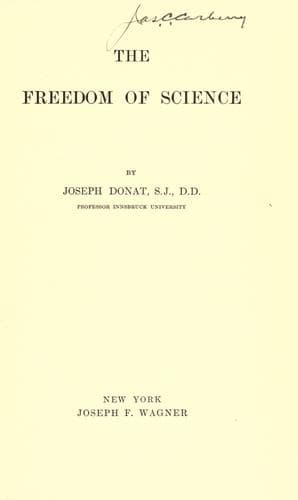
Free thought; Modernism (Christian theology) -- Catholic Church; Religion and science; Teaching, Freedom of
to have pronounced on _Columbus_.
But let us return to _Galileo_.(6)
_Galileo Galilei_, the great Italian physicist, was born in 1564, at Pisa.
At first he was professor in his native town, then at Padua, where he
taught the doctrine of _Ptolemy_, although at that time there was no
obstacle to accepting the Copernican system. In 1611 he became
mathematician at the court of _Cosimo II._ at Florence. His talents and
happy discoveries soon won fame. In general he was more of a physicist
than an astronomer; his astronomical discoveries were, almost without
exception, of a kind that did not presuppose a thorough astronomical
training. As is known, he was not the original inventor of the telescope,
though with its aid he achieved some of the most important of his
discoveries; for instance, that of the satellites of Jupiter. The
telescope was invented in Holland.
When he went to Rome, in 1611, he was received with great honour. In one
of his letters from there he wrote: “I have received marked favours from
many Cardinals and prelates here, and from several princes. They wanted to
hear of my inventions, and were all well pleased.” The Jesuits gave a
special reception in his honour at the Roman College. This shows in what
esteem science was then held at Rome. But five years later _Galileo_
returned to the Eternal City under quite different circumstances. What had
happened? In 1612 he had issued a treatise on “The History and Explanation
of the Sun-spots,” in which he declared unreservedly for the Copernican
system. And this caused the change. True, _Copernicus_ himself was a
Catholic Priest, and had dedicated his principal work to Pope _Paul III._
But it was generally supposed that he had brought forward the doctrine
only as an hypothesis, only to illustrate and facilitate calculations, not
claiming for it absolute certainty. This assumption was based on the
preface of the first edition of his book, containing assurance to that
effect. That preface, however, was not the work of _Copernicus_, but had
been smuggled into the book by the Protestant publisher _Osiander_,
without the author’s knowledge, because _Osiander_ feared _his own_ church
authorities.
_Galileo_ spoke in quite another tone. He defended the doctrine as true.
He soon aroused opposition. Men standing for the geocentric theory were
opposed by others, siding with _Galileo_ for the solar system, such as the
learned Benedictine, _Castelli_. _Galileo’s_ great bitterness and sarcasm
in dealing with his opponents aggravated the quarrel with the “partisans
of _Aristotle_.” Extreme irritability and love of praise were prominent
traits of _Galileo’s_ character.
Public-domain text, read in full here on John Shaqi.
Reviews
Reviews
No reviews yet
Be the first to share your thoughts on this work.
Elsewhere in the archive
Join the Discussion
Join the discussion
Sign in to leave a comment or review.
Sign InorCreate an account