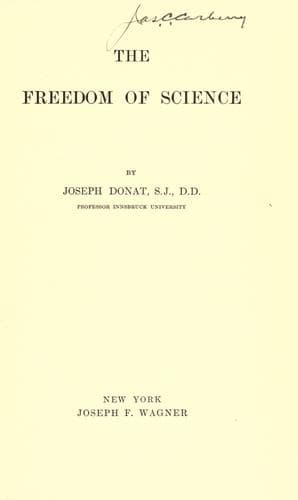
Free thought; Modernism (Christian theology) -- Catholic Church; Religion and science; Teaching, Freedom of
The scruples arose from the opinion, then prevalent, that the Holy
Scripture taught that the earth stood still and the sun moved; that the
words of the Scripture must be taken literally till the contrary is
demonstrated. The unanimous explanation of the Christian centuries was
also cited. As a matter of fact, however, the Christian past had not
taught this to be the only true sense of the words, but at that time the
words were understood that way, because no one could arrive at any other
sense in those days.
Under these circumstances, an error was hardly avoidable, if a decision
was required. And a decision seemed to be urgent, and this is the second
point we must not overlook, if we wish to judge fairly. It was a time
eager for innovations, full of anti-religious ideas. A renaissance,
sidling off into false humanism, was combating religious convictions,
false notions were invading philosophy; in addition, Protestantism was
trying to invade Italy. All this caused suspicion of any innovation apt to
endanger the faith; interpretations of the Scriptures deviating from the
accustomed sense were particularly distrusted. The _Galileo_ quarrel
happened at an inopportune time. Indeed a sudden spread of the Copernican
theory might have been accompanied by great religious dangers. Even now,
after nearly three hundred years, the leaders of the anti-Christian
propaganda are still pointing out that the progress of natural science has
proved Holy Scripture to be erroneous, and many are impressed by the
argument; many thousands would have been confused in those days by the
sudden collapse of old astronomical views that were connected with
unclarified religious ideas—dreading that victorious science might shatter
all religious traditions. Now, if one is convinced that the damage to
religion is to be estimated greater than any other, then one may also have
the conviction that it was better for the nations of the new era to have
their scientific progress a little delayed, than to have their most sacred
possession endangered. Of course considerations of this kind will have no
weight with representatives of the naturalistic view of the world. Then it
can only be emphasized that a science that has no appreciation of the
supernatural character of the Catholic Church cannot be in a position to
render a fair judgment on many facts in the history of that Church.
What we have said shows sufficiently that the condemnation of _Galileo_
was not due to any hostility to science.
Public-domain text, read in full here on John Shaqi.
Reviews
Reviews
No reviews yet
Be the first to share your thoughts on this work.
Elsewhere in the archive
Join the Discussion
Join the discussion
Sign in to leave a comment or review.
Sign InorCreate an account