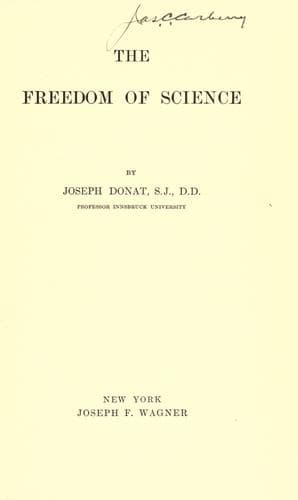
Free thought; Modernism (Christian theology) -- Catholic Church; Religion and science; Teaching, Freedom of
The idea that the Church’s attitude towards _Galileo_ and the
Copernican theory was a result of her antipathy to science is
entirely in contradiction with the character of that strenuous
period. In Catholic countries, especially in Italy, intellectual
life was zealously promoted by the Popes and their influence. It
was developing and flourishing even in the natural sciences. When
reading the correspondence of _Galileo_ one must be surprised to
see how popular astronomical, physical, and mathematical studies
were in the educated circles of the period. These studies belonged
to the curriculum of a general philosophical education, and it was
a matter of honour for many ecclesiastical dignitaries to remain
philosophers in that sense, notwithstanding their official duties.
We recall to mind the scientific discussion carried on with
_Galileo_ in Rome in 1611 and 1616, by Cardinals _Del Monte_,
_Farnese_, _Bonzi_, _Bemerio_, _Orsini_, and _Maffeo Baberini_,
and by clergymen like _Agucchi_, _Dini_, and _Campioli_. Similarly
in France we meet with names like _Mersenne_, _Gassendi_, and
_Descartes_. And in Italy, after _Galileo_ and at his time, we
meet with a long list of eminent naturalists like _Toricelli_,
_Cassini_, _Riccioli_, and others. In 1667 _Gemiani Montanari_
could write that in Italy there were continually forming new
societies of scientists. The advance in knowledge of truth was
made on safe grounds; at Naples, Rome, and elsewhere science was
enriched by a great variety of new experiences, inasmuch as the
scientists were making progress in the observation and the
investigation of nature. _Targioni-Tozzetti_ writes: “Astronomy
with us, about the middle of the sixteenth century, was a very
diligently cultivated branch of science” (Galileistudien (1882)
338 f.). The Church was by no means hostile to this newly awakened
life, not even holding aloof from it; on the contrary, it
flourished especially in ecclesiastical circles; a proof that
narrow-minded disappreciation of natural science did not prevail,
and that there was a different explanation for the _Galileo_ case.
Copernicus on the Index till 1835.
And what of the fact that _Copernicus_ remained on the Index until the
nineteenth century? Does it not show a rigid adherence to old, traditional
method and opposition to progress? The fact is true: The work of
_Copernicus_, and other Copernican writings, remained on the Index until
1835. But it is also true that a great deal connected with this fact is
not generally known or ignored. Let us mention here some of these facts.
Public-domain text, read in full here on John Shaqi.
Reviews
Reviews
No reviews yet
Be the first to share your thoughts on this work.
Elsewhere in the archive
Join the Discussion
Join the discussion
Sign in to leave a comment or review.
Sign InorCreate an account