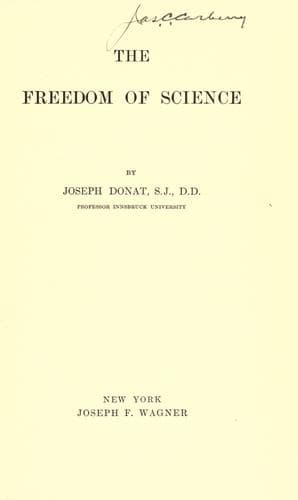
Free thought; Modernism (Christian theology) -- Catholic Church; Religion and science; Teaching, Freedom of
understanding for the saving institution of the Church, by whom he should
be led: she is to him an institution of intellectual serfdom. He makes his
own religion, free from dogma, just as his individuality desires, just as
he “lives” it.
Should our observer, while visiting the Protestant city, make a final
visit to its university, he will find there the thoughts, which hitherto
he had but vaguely felt, clothed in scientific language. There they meet
his gaze, defined sharply on the pedestal of Research as the Modern
Philosophy, protected, often exclusively privileged, by the state license
of teaching. It is the modern scientific view of the world, the only one
that men of modern times may hold. From here it is to find its way to
wider circles.
“Man,” we are told by a pupil of _Feuerbach_, in accord with his
master’s teaching, “man is man’s god. And only by the enthronement
of this human god can the super-human and ultra-human God be made
superfluous. What Christianity was and claimed to be in times gone
by, that now is claimed by humanity.” “The being which man in
religion and theology reveres,” continues _Jodl_ with _Feuerbach_,
“is his own being, the essence of his own desires and ideals. If
you eliminate from this conception all that is mere fancy and
contrary to the laws of nature, what is left is a cultural ideal
of civilization, a refined humanity, which will become a reality
by its own independent strength and labour” (_Ludwig Feuerbach_,
1904, 111 f., 194). “The greatest achievement of modern times,”
says another panegyrist of emancipated humanity, “is the
deliverance from the traditional bondage of a direct
revelation.... Neither revelation nor redemption approach man from
without; he is bound rather to struggle for his perfection by his
own strength. What he knows about God, nature, and his own self,
is of his own doing. He is in reality ‘the measure of all things,
of those that are, and why they are; of those that are not, and
why they are not.’ Of his dignity as an image of God, he has
therefore not lost anything; on the contrary, he has come nearer
to his resemblance to God, his highest end, by his consciousness
of being self-existent and of having the destiny to produce
everything of himself; from a receptive being he has become a
spontaneous one; he has at last come to a clear knowledge of his
own real importance and destiny” (_Spicker_, Der Kampf zweier
Weltanschauungen, 1898, 134).
Public-domain text, read in full here on John Shaqi.
Reviews
Reviews
No reviews yet
Be the first to share your thoughts on this work.
Join the Discussion
Join the discussion
Sign in to leave a comment or review.
Sign InorCreate an account