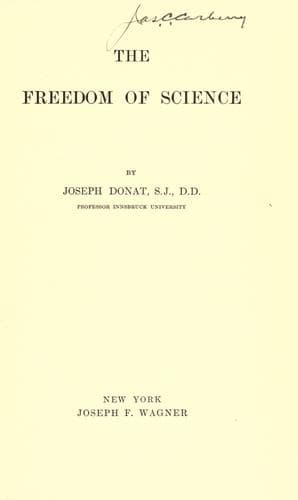
Free thought; Modernism (Christian theology) -- Catholic Church; Religion and science; Teaching, Freedom of
The modern view of man and his freedom has shaped itself gradually in
recent times; the present is ever the child of the past. The most
important factor in this development was undoubtedly the _Reformation_. It
emancipated man in the most important affair, religious life, from the
authority of the Church, and made him independent. “All have the right to
try and to judge what is right and wrong in belief,” so _Luther_ told the
Christian nobility of the German nation; “everybody shall according to his
believing mind interpret the Scriptures, it is the duty of every believing
Christian to espouse the faith, to understand and defend it, and to
condemn all errors.” Protestantism means even to the modern man “the
thinking mind’s break with authority, a protest against being fettered by
anything positive, the mind’s return to itself from self-alienation”
(_Schwegler_, Geschichte der Philosophie (1887), 167): “it puts out of
joint the Christian Church organization, and overturns its supernatural
foundation, quite against its will, but with an actual, and ever more
plainly visible, effect” (_E. Troeltsch_, Die Bedeutung des
Protestantismus fuer die Entstehung der modernen Welt (1906), 29).
The first step towards full autonomy was taken with energy; the
emancipation from external authority then progressed rapidly in the domain
of politics, sociology, economy, and especially of religion, to the very
elimination of everything supernatural. There came the English
individualism of the seventeenth century. The liberty of “individual
conviction,” termed also “tolerance,” in the sense of rejecting every
authoritative interference in the sanctuary of man’s thought and feeling,
was extolled; of course at first only as the privilege of those who were
intellectually superior. Soon the Deism of a _Herbert of Cherbury_ and
_Locke_ was reached; it was the religion of natural reason, with belief in
God and the obligation to moral action. Whatever is added by positive
religions, and therefore by the Christian religion, is superfluous; hence
not dogma, but freedom! _Locke_, indeed, denied to atheists state
toleration; but _J. Toland_ already advised full freedom of thought, even
to the tolerance of atheism. In the year 1717 _Freemasonry_ came into
existence in England. _Adam Smith_ originated the idea of a liberal
political economy which frees the individual from all bond, even in the
economic field. The views prevailing in England then exert great influence
in France. _Rousseau_ and _Voltaire_ appear.
Public-domain text, read in full here on John Shaqi.
Reviews
Reviews
No reviews yet
Be the first to share your thoughts on this work.
Join the Discussion
Join the discussion
Sign in to leave a comment or review.
Sign InorCreate an account