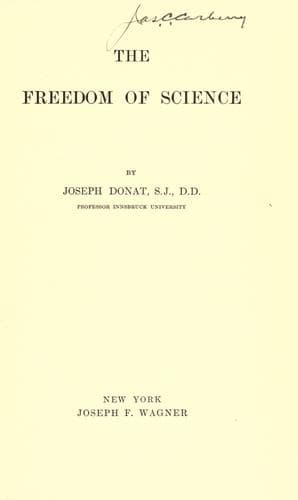
Free thought; Modernism (Christian theology) -- Catholic Church; Religion and science; Teaching, Freedom of
“Does Genesis relate history or a legend?” asks Prof. _Gunkel_,
and continues: “this is no longer a question to the historian.”
Well, a legend, then. But how does the historian know this? From
his own pantheistic philosophy, which recognizes no God differing
from this world: “The narratives of Genesis being mostly of a
religious nature, they continuously speak of God. The way,
however, in which narratives speak of God is one of the most
reliable standards to judge whether they are meant historically or
poetically. Here, too, the historian cannot do without a world
philosophy. We believe that God acts in the world as the latent,
hidden motive of all things ... but He never appears to us as an
acting factor _jointly with others_ (the italics are the
author’s), but always as the ultimate cause of all things. Quite
different in many narratives of Genesis. We are able to understand
these narratives of miracles and apparitions as the artlessness of
primitive people, but we refuse to believe them.”
Analogous to Bible-criticism is the research in other branches of
theology. The _origin of Christianity_, this wonderful power which so
suddenly made its appearance in history and speedily vanquished a whole
world, must of course not be a work of Heaven. Hence its origin must be
explained at any cost in a natural way, or “historically,” as they put it.
The religious notions of Christianity must not be conceded a supernatural
certainty over all other religions; and “to understand an event
historically means: to conceive it by its causal connection with the
conditions of a given place and at a certain time of the human life. Hence
science cannot consider such a thing as the appearance of a supernatural
being upon the earth” (_Pfleiderer_).
And then they proceed to show that Christianity is a natural, evolutionary
product of the Israelite religion, of Greek philosophy, of Oriental myths,
and Roman customs. That it is far superior to all these, and that it is
the opposite to them in various ways, is carefully hushed up. The
inadequacy and impossibility of such an explanation is adroitly concealed.
Nor could the Israelite religion of the Old Covenant, according to the
naturalistic principle of liberal theology, have had its origin in
revelation and the prophets; hence it comes from Babylon, as the product
of natural evolution from Oriental myths and customs. Any old and new
analogies, hypotheses, and fancies are good enough then to demonstrate
this as “historical.”
The Truth is not in Them.
Public-domain text, read in full here on John Shaqi.
Reviews
Reviews
No reviews yet
Be the first to share your thoughts on this work.
Elsewhere in the archive
Join the Discussion
Join the discussion
Sign in to leave a comment or review.
Sign InorCreate an account