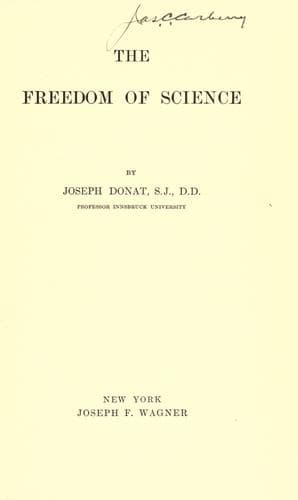
Free thought; Modernism (Christian theology) -- Catholic Church; Religion and science; Teaching, Freedom of
The writers were frauds—this was long ago the hypothesis of the
superficial Hamburg Professor, _Samuel Reimarus_, whose “Fragments” were
published by _Lessing_. But even to a _D. F. Strauss_ “such a suspicion
was repulsive.” The Heidelberg Professor, _H. E. Paulus_, sought his
salvation in trying to reduce the reports of miracles to a natural sense,
by doing painful violence to the text: for instance, the Lord did not walk
_upon_ the sea, but only _along_ the sea; the miracle of the wine at Cana
was only a wedding joke. Then came _D. F. Strauss_ (died 1874), and he
tried it in a different way. “If the Gospels are really historical
documents, then the miracle cannot be removed from the life of Jesus.”
Hence, it is to remain? Indeed not! The Gospels must not be accepted as
historical sources. They are products of purposeless poetic legends, the
miracles are garlands of religious myths, gradually twined around the
picture of Jesus. Myths, however, need time for their formation, hence
_Strauss_ fixes the date of the Gospels within the second century. He
openly admits that his hypothesis would fall to the ground if but a single
Gospel has been written in the first century. As a fact, more recent
rationalistic criticism has found itself constrained to drop this
hypothesis. _F. Ch. Baur_ (died 1860) fell back upon the fraud-hypothesis
of a _Reimarus_. It, too, has been laid among the dead. Thus they have
exhausted themselves in the attempt to shake off the burdensome yoke of
truth.
Influenced by _Strauss_, _Baur_, and other German critics, _E. Renan_
(died 1892) wrote his “Life of Jesus,” a frivolous romance. Quite frank
are the words he wrote down in the preface to the thirteenth edition of
his “Vie de Jésus” (1883): “If miracle has any reality, then my book is
nothing but a tissue of errors.... If the miracle and the inspiration of
certain books are real things, then our method is abominable.” But he
silences all doubts by the phrase: “To admit the supernatural is alone
sufficient to place one’s self outside of science.”
The newer “historical-critical” school, while having disposed of many
contentions of the old schools, is nevertheless in its research bound just
as energetically by the postulate of conformity to natural laws. The
fourth Gospel is pushed aside: in the others all miraculous occurrences
are expounded away, till the “historically credible core” is reached.
The books of the Old Testament fare even worse, if possible.
Public-domain text, read in full here on John Shaqi.
Reviews
Reviews
No reviews yet
Be the first to share your thoughts on this work.
Elsewhere in the archive
Join the Discussion
Join the discussion
Sign in to leave a comment or review.
Sign InorCreate an account