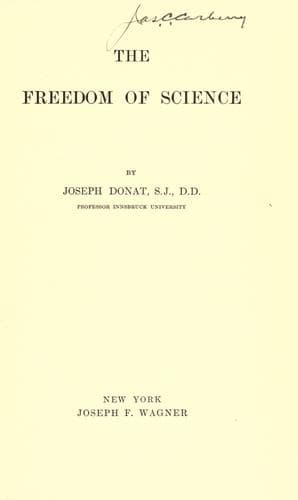
Free thought; Modernism (Christian theology) -- Catholic Church; Religion and science; Teaching, Freedom of
It would be highly instructive to take a longer journey through the realm
of modern philosophy, in so far as it touches upon questions concerning
the theory of the world, or even liberal Protestant theology, so as to
subject to a searching criticism the untenable notions and attempts at
demonstration even of acknowledged representatives of this science,
whereby they generally do away with God and miracles, the soul and
immortality, freedom of the will, the divine moral laws, the Gospel, the
divinity of Christ, and so much more, and show what they offer in place of
all this. It would disclose an enormous lack of scientific method: instead
of assured results they offer questionable, even untenable theories; in
place of proofs, emphatical assertions, imperatives, catch phrases; or
else arguments which under the simplest test will prove miscarriages of
logic. These philosophers vault ditches and boundaries with ease, and
derive full gratification from imperfect and warped ideas. Of course,
exactness in philosophical thinking is not a fruit to be plucked while out
taking a walk; it is the product of serious mental work, of sterling
philosophical training, which, alas, is wanting to-day in large circles of
scientists.
As an instance, we point to the method described in a previous chapter, by
which all supernatural factors are rejected by the arbitrary postulate of
“exclusively natural causation,” without valid proofs, based only upon the
arbitrary decision of so-called modern science—in the gravest matter an
unscientific process that cannot be outdone.
Another instructive instance, of serious matters treated with levity, is
furnished in the unscrupulous way in which the Catholic Church, her
teaching, institutions, and history, are passed upon in judgment by those
having neither knowledge nor fairness.
Without Reverence.
Public-domain text, read in full here on John Shaqi.
Reviews
Reviews
No reviews yet
Be the first to share your thoughts on this work.
Elsewhere in the archive
Join the Discussion
Join the discussion
Sign in to leave a comment or review.
Sign InorCreate an account