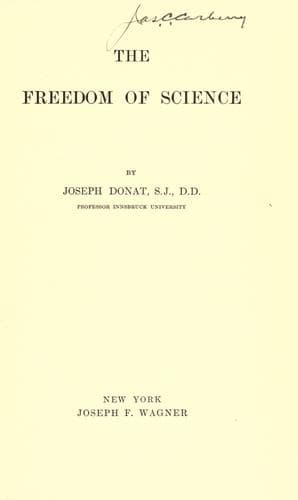
Free thought; Modernism (Christian theology) -- Catholic Church; Religion and science; Teaching, Freedom of
True wisdom accepts advice and guidance. It feels reverence for sacred and
venerable traditions, for the convictions of mankind on the great
questions of life, and greater reverence still for an authority of faith
that has received from God its warrant to be the teacher of mankind, and
which has stood the test of time. True wisdom is convinced that continuity
in human thinking and in knowledge is necessary. Life is short, and gives
to the individual hardly time to attain mental maturity. Philosophy, and
this is the matter before us at present,—philosophy can never be the work
of a single person; it is the achievement of centuries; succeeding
generations, with searching eye and careful hand, building further upon
the achievement for which past ages have laid the foundations. By nailing
together beams and boards the individual may erect a house good enough for
a short time to serve his sports and pleasures; and if wrecked by the
first storm, it may be replaced by another. But the building of massive
and towering cathedrals that last for ages required the work of
generations. And only skilful and experienced hands may do the work; haste
is out of place here. The ancient sages of Greece, _Plato_, _Pythagoras_,
and _Aristotle_, had this reverence for the philosophical and religious
traditions of the past. These representatives of true wisdom did not
consider philosophy and theology as the product of individual sagacity,
they did not attempt to be free rulers in the realm of thought; on the
contrary, they looked upon wisdom as the patrimony of the past, which it
was their duty to preserve.
Public-domain text, read in full here on John Shaqi.
Reviews
Reviews
No reviews yet
Be the first to share your thoughts on this work.
Elsewhere in the archive
Join the Discussion
Join the discussion
Sign in to leave a comment or review.
Sign InorCreate an account