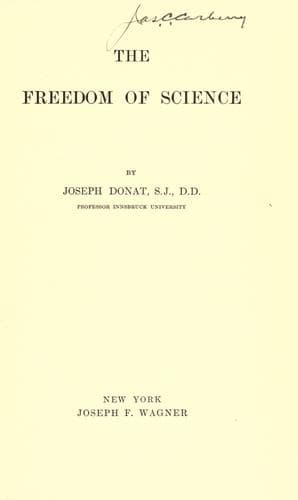
Free thought; Modernism (Christian theology) -- Catholic Church; Religion and science; Teaching, Freedom of
This is called the development of Christianity. It is this
“religious progress,” the same “free Christianity,” that they are
now trying to promote by international congresses. The invitation
to the “World’s Congress for free Christianity and religious
progress” at Berlin, in 1910, was signed by more than 130 German
professors, including 47 theologians. We have here the development
of the dying into the lifeless corpse, the progress of the strong
castle into a dilapidated ruin, the advance of the rich man to
beggary.
We began our inquiry with the question proposed some years ago by _D.
Strauss_ to his brethren-in-spirit: Are we still Christians? We may now
quote the answer, which he gives at the conclusion of his own
investigation: “Now, I think, we are through. And the result? the reply to
my question?—must I state it explicitly? Very well; my conviction is, that
if we do not want to make excuses, if we do not want to shift and shuffle
and quibble, if yes is to be yes, and no to remain no, in short, if we
desire to speak like honest, sincere men, we must confess: we are no
longer Christians.”
This is the bitter fruit of autonomous freedom of thinking, which,
declining any guidance by faith, recognizes no other judge of truth than
individual reason, with all the license and the hidden inclinations that
rule it. Protestantism has adopted this freedom of research as its
principle; in consistently applying it, Protestantism has completely
denatured the Christian religion. If anything can prove irrefutably the
monstrosity and cultural incapacity of modern freedom of research, it is
the fate of Protestantism. Any one capable of seriously judging serious
things must realize here how pernicious this freedom is for the human
mind.
Reduced to Beggary.
But the loss is even greater. The better class of paganism still clung to
the general notion of an existing personal God, of a future life, of a
reward after death; it was convinced of the existence of an immortal soul
and a future reward, of the necessity of religion, of immutable standards
for morals and thought. Has liberal science at least been able to preserve
this essential property of a higher paganism? Alas, no! It has lost nearly
everything.
Public-domain text, read in full here on John Shaqi.
Reviews
Reviews
No reviews yet
Be the first to share your thoughts on this work.
Elsewhere in the archive
Join the Discussion
Join the discussion
Sign in to leave a comment or review.
Sign InorCreate an account