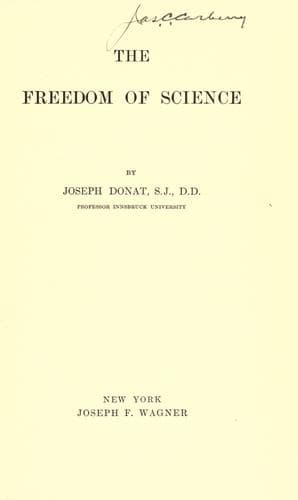
Free thought; Modernism (Christian theology) -- Catholic Church; Religion and science; Teaching, Freedom of
No longer has it a personal God. While belief in God may still survive in
the hearts of many representatives of this science, it has vanished from
science itself. It begs to be excused from accepting any solution of
questions, if God is a factor in the solution. The opinion prevails that
_Kant_ has forever shattered all rational demonstrations of the existence
of God. Yet _Kant_ permits this existence as a “postulate,” which,
according to _Strauss_, “may be regarded as the attic room, where God who
has been retired from His office may be decently sheltered and employed.”
But now He has been given notice to quit even this refuge. There must be
nothing left of Him but His venerable name, which is appropriated by the
new apostasy in the guise of pantheism or a masked materialism. Monism is
the joint name for it: this is the modern “belief in God.” In days gone by
it was frankly called “atheism.”
This disappearance of the old belief in God is noted with
satisfaction by modern science: “It is true,” says _Paulsen_, “the
belief in gods ... is dying out, and will never be resurrected.
Nor is there an essential difference whether many or only one of
these beings are assumed. A monotheism which looks upon God as an
individual being and lets him occasionally interfere in the world
as in something separate from and foreign to him, such a
monotheism is essentially not different from polytheism. If one
should insist on such conception of theism, then, of course, it
will be difficult to contradict those who maintain that science
must lead to atheism.”
Therefore God, as a personal being, is dead, and will never come to life
again. While there is an enormous exaggeration in these words, they
nevertheless glaringly characterize the ideas of the science of which
_Paulsen_ is the mouthpiece. It does not want directly to give up the name
of God; it serves as a mask to conceal the uncanny features of pantheism
and materialism.
“The universe,” we hear often and in many variations, “is the
expression of a uniform, original principle, which may be termed
God, Nature, primitive force, or anything else, and which appears
to man in manifold forms of energy, like matter, light, warmth,
electricity, chemical energy, or psychical process.... These
fundamental ideas of monism are by no means ‘atheistic.’ Many
monists in spite of assertions to the contrary believe in a
supreme divine principle, which penetrates the whole world, living
and operating in everything. Of course, if God is taken to mean a
being who exists outside of the world ... then it is true we are
atheists” (_Plate_). We have already seen that one can even be a
Protestant theologian and yet be satisfied with a “God” of this
description.
Public-domain text, read in full here on John Shaqi.
Reviews
Reviews
No reviews yet
Be the first to share your thoughts on this work.
Elsewhere in the archive
Join the Discussion
Join the discussion
Sign in to leave a comment or review.
Sign InorCreate an account