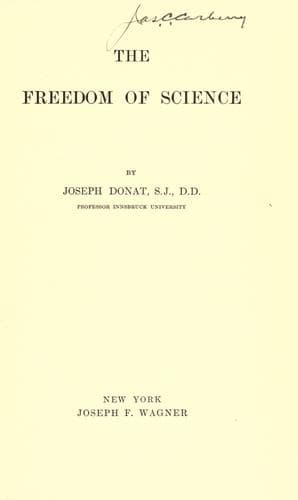
Free thought; Modernism (Christian theology) -- Catholic Church; Religion and science; Teaching, Freedom of
Where is left now to liberal science a single remnant of those great
truths on which mankind has hitherto lived, and which it needs for
existence? There was a God—but He is gone. There was a life to come, and a
supernatural world; they are lost. Man had a soul, endowed with freedom,
spirituality, and immortality; he has it no longer. He had fixed
principles of reasoning and laws of morals; they are gone. He possessed
Christ, full of grace and truth, he possessed redemption and a Church;
everything is lost. Burnt to the ground is the homestead. In the blank
voids, that cheerful casements were, sits despair; man stands at the grave
of all that fortune gave!
The names alone have survived; now and then they speak of God and
religion, of Christianity and faith, immortality and freedom; but the
words are false, pretending a possession that is lost long since. They are
patches from a grand dress, once worn by our ancestors; ruins of the
ancestral house that the children have lost. They are still cherished as
the memories of better times. People thus acknowledge the irreparable
forfeiture which those names denote, without realizing how they pronounce
their own condemnation by having destroyed these possessions.(16)
_Dissipaverunt substantiam suam._
The son came to his father. In his heedless anxiety for freedom he would
leave the father’s house, to get away from restraining discipline and
dependence. “Father, give me the portion of the goods that falleth to me.”
And he departed into a far country. Soon he had spent all and had nothing
to appease his hunger.
Despairing of Truth.
These, then, are the achievements liberal research can boast of in the
fields of philosophy and religion: Negations and again negations; temples
and altars it has destroyed, sacred images it has broken, pillars it has
knocked down. Free from Christianity, free from God, free from the life to
come and the supernatural, free from authority and faith—it is rich in
freedom and negation. But what does it offer in place of all the things it
has destroyed? What spiritual goods does it show to the expectant eyes of
its confiding followers? The most hopeless things imaginable, namely,
despair of all higher truth, mental confusion, and decay. One other brief
glance at the consequences and we shall be competent to judge of the
fitness of liberal freedom of thought for the civilization of mankind.
As far as it is inspired by philosophy, modern science confesses the
principle: “No objective truth can be positively known, at least not in
metaphysics”; restless doubt is the lot of the searching intellect. We
have amplified this elsewhere in these pages. This result of the modern
doctrine of cognition is not infrequently boasted of. It was good enough,
say they, for the ancients to live in the silly belief of possessing
eternal truth; they were simple and unsuspecting; we know there is in
store for man only doubt and everlasting struggle for truth.
Public-domain text, read in full here on John Shaqi.
Reviews
Reviews
No reviews yet
Be the first to share your thoughts on this work.
Elsewhere in the archive
Join the Discussion
Join the discussion
Sign in to leave a comment or review.
Sign InorCreate an account