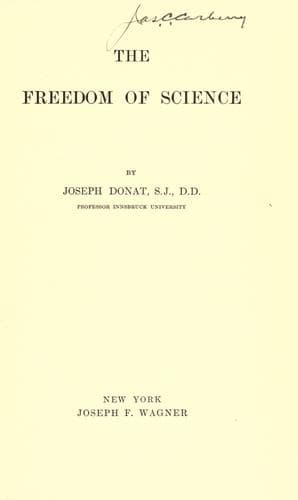
Free thought; Modernism (Christian theology) -- Catholic Church; Religion and science; Teaching, Freedom of
To the believing Christian a different grave opens on Easter day. From it
comes the risen God-man; in His hand the banner of immortal victory. It
points the way to true human greatness, to a superior humanity according
to the will of God. Man longs for perfection; he longs to go beyond the
narrow limits of his present condition. But modern man wants to rise to
greatness by his own strength, without help from above; he would rise with
giant bounds, without law. In his weakness he falls; error and scepticism
and the loss of morality are the bitter fruit. Another way is pointed out
by the great Friend of Man. Humanity is to be led on the way of progress
by the hand of God, by faith in God, supported by His grace; thus man
shall participate in God’s nature, shall one day attain his highest
perfection in eternal life, far beyond the limits of his present
condition. “I am the way, the truth, and the life.”
Chapter III. Subjectivism And Its Freedom.
The tendency of the modern intellect to independence in its own peculiar
sphere of thinking and knowing, cannot fail to work itself out
energetically. In this sphere it leads naturally to that view of human
reasoning called subjectivism: the thinking or reasoning subject is its
own law, the autonomous creator and guide of its thought. Herein lies the
_essential presumption_, the very core, of the liberal freedom of science.
Wherever we turn we meet subjectivism with its autonomous rejection of all
authority, its arbitrary separation of knowledge from faith, its
agnosticism, its relativity to truth as the moving factor of, and the
ostensible warrant for, this freedom, especially in the sphere which it
considers peculiarly its own, philosophy and religion. Only when we look
closer into its philosophical premises will it be possible to form a
judgment of the “scientific method” it employs in this, its peculiar
sphere, and of the justice of its claim to be the sole administrator of
man’s ideal possessions, and to be altogether “independent of every view
not conforming to this scientific method.” Before considering subjectivism
let us by way of preface set down a few considerations on the nature of
human, intellectual perception.
Objectivism and Subjectivism.
It always has been, and still is, the firm conviction of unbiassed men,—a
conviction which irresistibly forces itself upon us,—that in our
intellectual perception and thought we grasp an _objective, exterior order
of things, an existence distinct from our thought_; of this objective
reality we reproduce an image in our minds, and thus grasp it
intellectually. _Cognitio est similitudo rei_, says the old school; that
is, Knowledge is the reproduction of an objective reality, which thus
becomes the criterion of cognition. The reproduction is a counterpart of
the original. In this perfect resemblance of our cognition to the
objective reality there has ever been recognized the _truth_ of knowledge.
Public-domain text, read in full here on John Shaqi.
Reviews
Reviews
No reviews yet
Be the first to share your thoughts on this work.
Join the Discussion
Join the discussion
Sign in to leave a comment or review.
Sign InorCreate an account