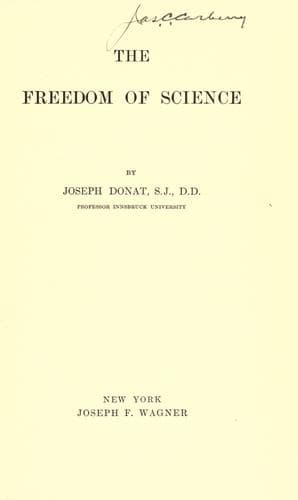
Free thought; Modernism (Christian theology) -- Catholic Church; Religion and science; Teaching, Freedom of
But before we begin our study, let us remember a rule of the great orator
and philosopher of ancient Rome; a rule only too often forgotten in our
times: “Every philosophical discussion, of anything whatsoever, should
begin with a definition, in order to make clear what the discussion is
about” (_Cicero_, De Officiis, I, 2). If we would form a judgment as to
the demand of science for freedom, as to the justification of this demand,
as to its compatibility or incompatibility with the duty of faith, the
first question that naturally arises is: What is the purport of this
demand, what does it mean? Only after we have clearly circumscribed this
demand can we approach its philosophical presumptions and test its basis.
What, then, do we understand by Science, and what freedom may be granted
to it?
Science.
When a man of Northern or Central Europe hears of science, his thoughts
generally turn to the universities and their teachers. To him the
university is the home of science, there its numerous branches dwell in
good fellowship, there hundreds of men have consecrated themselves to its
service. In those parts of Europe it is customary for men of science to be
university professors. Of what university is he? is asked. Celebrated
scientists, like _Helmholtz_, _Liebig_, _Hertz_, _Kirchhoff_;
philosophers, like _Kant_, _Fichte_, _Schelling_, _Hegel_, _Herbart_;
great philologists, historians, and so on, were university professors.
For all that, _science_ and _university_ are not necessarily inseparable
things. The university needs science, but science does not absolutely need
the university. Science was in the world before the twelfth and thirteenth
centuries, the time when France and Italy built their first universities;
and also since then science has been enriched by the achievements of many
a genius who never occupied a university chair. _Pythagoras_, _Aristotle_,
_St. Augustine_ belonged to no universities; _Copernicus_, _Newton_, and
_Kepler_ never taught in the higher schools. In the countries of Western
Europe and America the man of science and the university professor are to
this day not so much identical in person. Therefore, if the freedom of
science applies _principally_ to the higher schools and their teachers,
this is not its exclusive application. Science and university are not
identical terms.
What, then, is science?
At the sound of this magic word there arises in the minds of many the
image of a superhuman being: open on his lap lies the book of wisdom in
which all mysteries are solved; in his hand is the flaming torch which
enlightens the path down into the lowest depths of research, dispelling
all darkness. This, in the minds of many, is what science means. The mere
appeal to this infallible being suffices to settle all problems, to
silence every contradiction; woe to him who dares open his profane mouth
to utter an If or a But!
Public-domain text, read in full here on John Shaqi.
Reviews
Reviews
No reviews yet
Be the first to share your thoughts on this work.
Join the Discussion
Join the discussion
Sign in to leave a comment or review.
Sign InorCreate an account