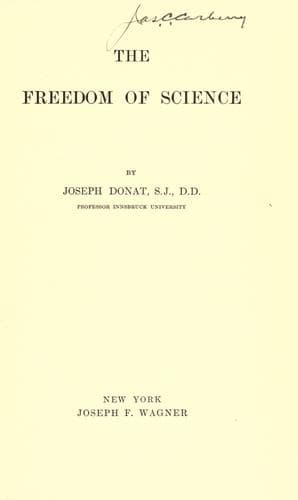
Free thought; Modernism (Christian theology) -- Catholic Church; Religion and science; Teaching, Freedom of
We often meet with the most inconceivable notions. We are told quite
seriously that the Church teaches, and that the Catholic has therefore to
believe, that the earth is a flat disc surrounded by the sea, as the
ancients believed; above it is a vault, below it hell-fire; that the earth
stands still and the sun and stars revolve about it, just as _Ptolemy_ of
Egypt taught; that God created the whole world just as it is now in
exactly six days of twenty-four hours each; that He made the sun and moon,
just as they are now illuminating the skies; that the strata, just as they
now look when bared by the geologist’s hammer, even the coal-fields and
petrified saurians and fossils—all were made, just as they now are, well
nigh six thousand years ago. The Scriptures teach this, the Fathers of old
and the theologians believe this: and that is where the Catholic must get
his science. And then they are astonished, and consider dogma retreating
before science, when they see other notions prevailing, when they see
Catholic scientists defend without prejudice the evolution of the solar
system, and even the system of the whole universe, from some primitive
matter, or assume an organic evolution, as far as science supports it (cf.
_Braun_, Ueber Kosmologie u. Standpunkt christlich. Wiss., 2d ed., 1906,
etc.). They would be still more astonished perhaps to learn that similar
ideas had long ago been proposed by _St. Augustine_ and _St. Thomas_ (cf.
Summa c. G. l. 3, c. 77; _Knabenbauer_, in Stimmen a. M. Laach xiii, 75
_seq._).
A distinction must be made between the teaching of the Church and the
private views of individuals, schools, or periods. Only the teaching of
the Church is the obligatory standard of Christian and Catholic thought,
not the opinion of individuals. Hence not everything that Catholic savants
have held to be true belongs to the teaching of the Church. Only when
theologians unanimously declare something to be contained in the deposit
of revealed truth, or the teaching of the Church,—only then is their
teaching authoritative; not because it is the teaching of theologians, but
because it is contained in revelation or the teaching of the Church. Else
the maxim holds good: _Tantum valet auctoritas, quantum argumenta_. Nor is
all that which a former age found in Holy Scripture, therefore to be
believed as revealed truth, to the exclusion of all other interpretations.
Public-domain text, read in full here on John Shaqi.
Reviews
Reviews
No reviews yet
Be the first to share your thoughts on this work.
Elsewhere in the archive
Join the Discussion
Join the discussion
Sign in to leave a comment or review.
Sign InorCreate an account