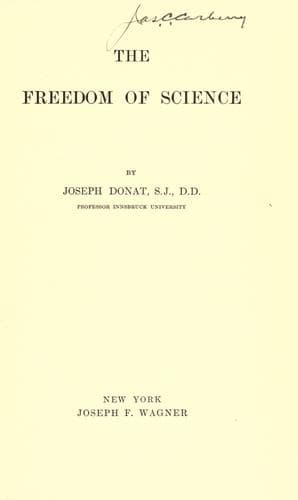
Free thought; Modernism (Christian theology) -- Catholic Church; Religion and science; Teaching, Freedom of
If science, then, can only with difficulty lift from visible
nature the veils that hide the truth—and even this is often beyond
its power—no wonder it is confronted with still greater obstacles
when it approaches the truths that are beyond visible nature.
Moreover, it is an old truth that here it is led not by reason
only, but also, and even more energetically, by self-interest.
“Most men,” says _Cicero_, “are swayed in their judgments by
either love or hatred, likes or dislikes” (De Oratore, II, 42).
If this is the nature of human science, its adepts would be badly
deceiving themselves, if, in the pride of learning, they would reject
every correction, even proudly pushing aside the hand of God that reaches
down into the darkness of man’s intellectual life to offer its guidance.
He who realizes that he is in danger of losing his way in the dark, will
not reject a reliable guide; and he who fears to stumble will not refuse a
helping hand. Self-knowledge is the sister of wisdom, and the mother of
modesty.
Freedom.
Such, then, is science: not the goddess that emanated from the head of
immortal Jove, but the offspring of the puny mind of man, bone of his bone
and flesh of his flesh. And this science cries for freedom. It would be
free and act freely; it urges its claim in the name of truth, which must
not be slighted; in the name of the progress of civilization, which must
not be hindered.
_Freedom_ clearly means nothing less than to be untrammeled and free from
restraint, from fetter and check, in action, thought, and desire. The
prisoner is free when his chains drop off, a people is free when it has
cast off the yoke of serfdom, the eagle is free and can spread out its
wings in lofty flight when not bound down to the earth. Science,
therefore, should be free in its activity from bond, fetter, and
restraint. Does this mean it must be free from _all_ restraint and law?
Should the historian be given the right to make _Solon_ a member of the
French Academy, or of the heroes of Troy mediæval knights? Should the
scientist be given the right to break every rule of logic, to ignore all
progress, and perhaps in his capriciousness return to the four elements of
_Aristotle_, or the astronomical chart of primitive ages? Nobody demands
this. No, science must be bound by the _truth_. Freedom indeed should not
mean lawlessness. Science remains bound by the general laws of logic, and
by positive facts. Truth is the irremovable barrier set in restraint of
the freedom of everything, even of scientific thought. The freedom of
science therefore can only be freedom from _unreasonable_ restraint and
fetters; from such that hinder it unreasonably in its inquiry after the
truth, and in the communication of the results of its investigation. _It
should be free, not from the internal bondage of truth, but from the
restraint by external authority_, the restraint which would hinder it, in
Public-domain text, read in full here on John Shaqi.
Reviews
Reviews
No reviews yet
Be the first to share your thoughts on this work.
Join the Discussion
Join the discussion
Sign in to leave a comment or review.
Sign InorCreate an account