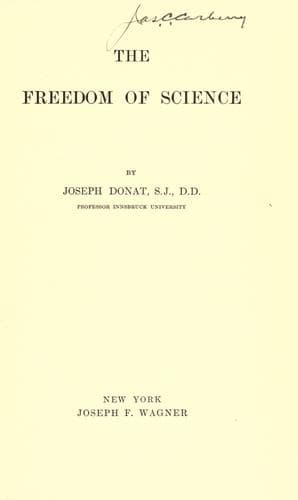
Free thought; Modernism (Christian theology) -- Catholic Church; Religion and science; Teaching, Freedom of
These condemnations stirred up anger: “Now,” it was said, “the
Church wants to subject the whole of human knowledge to her
judgment: this is unbearable insolence.” But what follows from
these condemnations? The opposite truth asserted in them is this:
the Church in one respect must pass judgment on the assertions
made by human science, namely, in so far as they come in conflict
with the doctrines of faith. The only freedom rejected by the
Council is the freedom to contradict revealed truth: it must not
be held “that human science may be pursued with freedom, that its
assertions can be considered true and must not be rejected by the
Church even if they contradict a revealed doctrine.” (sess. III,
ch. 4, can. 2). The Church does not want to judge on matters of
profane science; but she claims the right, due to her as guardian
appointed for the preservation of the pure faith, to raise her
warning voice when, for instance, natural science transgresses its
limits and trespasses on the province of religion by denying the
creation of the world. It is but self-defence against an attack
upon her inviolable domain. But she does not claim the authority
to sit in judgment upon the results of astro-physics, upon the
atom-hypothesis, or its opposite; or on the acceptance of a theory
about ions or earthquakes.
Another question may be touched upon: Is the _Catholic historian_ free to
proceed steadily in the search after historic truth, even where he
discovers facts which do not reflect honour on his Church? And where it is
a question of uncertain, private revelation, of doubtfulness of relics and
other sacred objects exposed for public worship, may he proceed
undisturbed with his critical research, or is he restrained by
ecclesiastical authority?
Should the Catholic meet with dark passages in the history of his Church,
then every well-meaning observer will demand that he display in the
treatment of such matters a pious forbearance for his Church. His respect
for her will dictate this. Unsparing criticism and hunting for blemishes
and shadows must be excluded. But he cannot on this account be bound to
pass by the unpleasant facts he may meet in his researches, or to cloak or
deny them against his better knowledge. He knows that the divinity of his
Church shows itself to best advantage just because, notwithstanding many
weaknesses and faults, past and present, she passes unvanquished and
imperishable through all storms,—a token of the supernatural origin of her
strength and power of endurance.
Public-domain text, read in full here on John Shaqi.
Reviews
Reviews
No reviews yet
Be the first to share your thoughts on this work.
Elsewhere in the archive
Join the Discussion
Join the discussion
Sign in to leave a comment or review.
Sign InorCreate an account