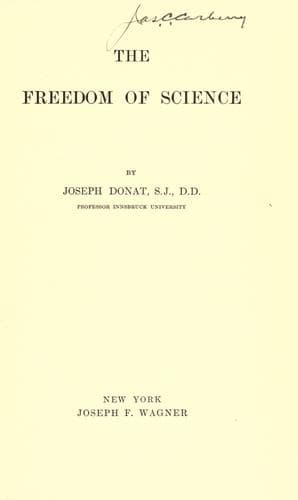
Free thought; Modernism (Christian theology) -- Catholic Church; Religion and science; Teaching, Freedom of
It was this very thought that moved _Leo XIII._ to open the Vatican
Archives for freest research to friend and enemy,—the clearest proof that
could possibly be given that the Church does not fear historical truth. In
his letter of admonition, of August 18, 1883, urging the fostering of
historiography, the same Pope gives the following rules for the Catholic
scientist: “The first law of history is that it must not say anything
false; the second, that it must not be afraid of saying the truth, lest a
suspicion of partiality and unfairness arise.” An excellent example of the
application of these rules is found in _L. v. Pastor’s_ “History of the
Popes,” especially in what he says about _Alexander VI._ and _Leo X._
In his historical investigation of private revelations, such as those of
_St. Gertrude_, _St. Mechtild_, _Bl. Juliana of Liège_, or of relics and
objects of veneration, the historian is likewise not restricted by
Church-direction. Having merely the task of preserving the treasure of the
faith received from Christ and the Apostles, the Church in her function as
Teacher never vouches for the divine origin of new, private revelations,
nor for the accuracy of pious traditions of another kind. True, she
decides authoritatively whether private revelations contain anything
against faith and morals, but she decides nothing more. If she accepts
such revelations or traditions as genuine, she claims for the facts in
question only that human faith which corresponds to their historical
proof.
Public-domain text, read in full here on John Shaqi.
Reviews
Reviews
No reviews yet
Be the first to share your thoughts on this work.
Elsewhere in the archive
Join the Discussion
Join the discussion
Sign in to leave a comment or review.
Sign InorCreate an account