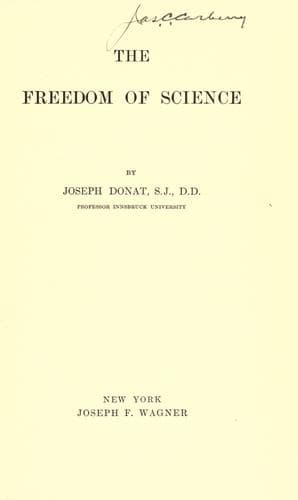
Free thought; Modernism (Christian theology) -- Catholic Church; Religion and science; Teaching, Freedom of
According to Catholic teaching, the universal teaching body of the Church,
when declaring unanimously to be an object of faith something relating to
faith and morals, is endowed with _infallibility_, and also when in its
daily practice of the faith it unanimously professes a doctrine to be a
truth of faith. This infallibility is also possessed by the Pope alone
when, acting in his capacity as Supreme Teacher of the Church in matters
of faith and morals, he intends to give a permanent decision for the whole
Church (ex cathedra).
Besides these infallible teachings there are also _non-infallible_
teachings, and they are the more frequent. Such are, first of all, the
ordinary doctrinal utterances of the Pope himself in his regular
supervision of the teaching of doctrine: these instructions and
declarations are of a lower kind than those peremptory ones that are
pronounced ex cathedra: he is infallible only in the utterance of these
ultimate, supreme decisions, the chief bulwark, as it were, erected
against the floods of error. Decisions ex cathedra are very rare.
Encyclical letters, too, are, as a rule, not infallible. It is
self-evident that the theological opinions and statements of the Pope as a
private person, not as Supreme Head of the Church, do not belong here at
all. They have no official character and are in no way binding.
Among decisions that are not infallible are further included, in various
degrees, the doctrinal utterances of Bishops, of particular synods, and
especially those of the Roman Congregations. The latter are bodies of
Cardinals, delegated by the Head of the Church, as highest Papal boards,
to co-operate with him in the various offices of administration. Of these,
the Congregation of the Holy Office and that of the Index may also render
decisions on doctrinal questions. Although the Congregations act by virtue
of their delegation from the Pope, and publish their decrees with his
consent, the decisions are not decisions of the Pope himself, but remain
decisions of the Cardinals. Much less can the infallibility of the Pope
pass over to them: it is his personal prerogative, the aid of the Holy
Ghost is promised to him, and protects his judgments under certain
conditions against error.
Public-domain text, read in full here on John Shaqi.
Reviews
Reviews
No reviews yet
Be the first to share your thoughts on this work.
Elsewhere in the archive
Join the Discussion
Join the discussion
Sign in to leave a comment or review.
Sign InorCreate an account