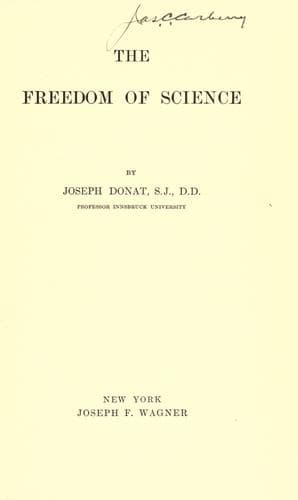
Free thought; Modernism (Christian theology) -- Catholic Church; Religion and science; Teaching, Freedom of
But the Catholic owes submission also to the non-infallible teachings; and
not only an outer submission, a reverent silence, that offends not either
verbally or in writing against the decision rendered, but he owes also his
inner assent. But it cannot be that unconditional inner assent which he
owes to the infallible decision, for this he holds to be irrevocably
certain; nor is his assent to non-infallible decisions a real act of
faith. He is not given any unconditional guarantee of the truth. An error
is, of course, most unlikely, but not absolutely impossible. Hence the
faithful Catholic should always be ready to accept such decisions in as
far as they are warranted by recognized truth. This applies to all kinds
of doctrinal teaching, but of course in different ways, corresponding to
the degree of authority,—for instance, Papal decisions are of higher
authority than those of the Congregations,—yet it applies also to the
doctrinal decisions of the Congregations, because they are the ordinary
teaching organs of the Church.
When the Congregation of the Index, 1857, had forbidden the works
of _Guenther_ and many thought they could evade the decision,
_Pius IX._ wrote, June 15, to the Archbishop of Cologne: “The
decree is so far-reaching that nobody may think himself free not
to hold what we have confirmed.” Similar was what the Pope had
written to the Archbishop of Mecheln after the condemnation of the
ontological errors of _Ubagh_. The Motu proprio of _Pius X._ of
November 8, 1907, speaks similarly of the obligation of submission
to the decisions of the Papal Biblical Commission relating to
doctrines, and to the decrees of Congregations when approved by
the Pope. (Cf. also the Syllabus of Pius IX., sent. 22.)
Theologians agree that this requisite internal assent is not the
same as irrevocable assent. This was also declared by _Pius IX._
in his letter to the Archbishop of Munich-Freising, saying that
this inner submission is by no means faith; and no theologian will
ascribe infallibility to a mere congregational decree. (See on
this point: _e.g._ _Grisar_, Galileistudien, 1882, 171 _seq._ Cr.
_Pesch_, Theol. Zeitfragen, Erste Folge, 1900, III. _Egger_,
Streiflichter ueber die freiere Bibelforschung, 1889.)
Public-domain text, read in full here on John Shaqi.
Reviews
Reviews
No reviews yet
Be the first to share your thoughts on this work.
Elsewhere in the archive
Join the Discussion
Join the discussion
Sign in to leave a comment or review.
Sign InorCreate an account