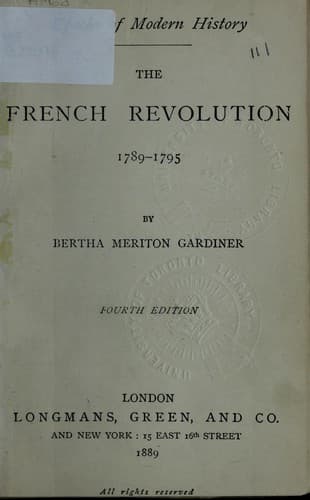
The French Revolution 1789-1795Gardiner, Bertha Meriton
History
The French Revolution 1789-1795
Gardiner, Bertha Meriton
France -- History -- Revolution, 1789-1799
The departments accepted passively the results of the insurrection of
August 10. Men feared lest by offering opposition they might render
easier the advance of the allies. Lafayette, while he prepared to
defend the road to Paris, refused to recognise the validity of what had
been done. The Assembly declared him a traitor, his soldiers abandoned
him, and, in company with three other members of the late constituent
Assembly, he fled across the frontier, where all four were arrested and
imprisoned by the Austrians. The Assembly itself had lost all control
over the course of events. The men who had refused to take the right
step of deposing Louis had now to pay the penalty. That which might
have been effected without shock by the constituent or legislative
Assembly had been done by a violent explosion of popular wrath. The
Assembly had failed to take the lead, and after its flagrant subjection
to mob dictation, it was without moral energy or force. Yet a mob,
however powerful to destroy, is powerless to reconstruct. The one
organised force in Paris which could translate the feelings of the
populace into action was that of the sixty or seventy commissioners
who had dispersed the legal Municipal Council on the night before the
insurrection. A few days afterwards they raised their number by fresh
elections to 288. From henceforth this irregularly-elected body is
known to history as the Commune of Paris. With this new Commune supreme
power for the moment practically resided. It was strong because it
knew its own mind, and because it fully accepted the work of those of
its members who had swept away a king suspected of being in alliance
with a foreign enemy. Among the newly-chosen members was Robespierre,
the only one who had hitherto been of note. Other names, such as those
of Billaud-Varennes, Collot d’Herbois, Hébert and Chaumette now rose
first into prominence. Of the mass many were unprincipled adventurers,
others timid timeservers. ♦The insurrectionary Commune.♦ To a few the
holding of municipal office was merely a step in their career upwards.
The better men resigned office or kept out of sight, the more ruffianly
and unscrupulous came to the front. The ministers were thwarted and
disobeyed, the Assembly threatened, public property plundered, numbers
of arrests made, liberty of speech suppressed. Constitutionalists
for the most part kept away from the Assembly, and laws were passed
which before the insurrection had been rejected by large majorities.
Nonjurors were required to leave the country within fifteen days on
pain of ten years’ imprisonment; and unbeneficed ecclesiastics, on
whom the oath had never been imposed, were subjected to the same fate
whenever six citizens of their department joined in demanding their
exile. Emigrants’ property was confiscated and offered for sale.
Administrative bodies and municipalities were authorised to issue
warrants of arrest against persons suspected of political crime. This
Public-domain text, read in full here on John Shaqi.
Reviews
Reviews
No reviews yet
Be the first to share your thoughts on this work.
Elsewhere in the archive
Join the Discussion
Join the discussion
Sign in to leave a comment or review.
Sign InorCreate an account