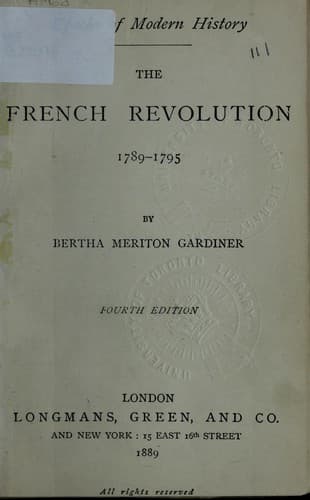
The French Revolution 1789-1795Gardiner, Bertha Meriton
History
The French Revolution 1789-1795
Gardiner, Bertha Meriton
France -- History -- Revolution, 1789-1799
law, which may be likened to a suspension of the Habeas Corpus Act in
England, destroyed at a blow the safeguards against arbitrary arrest
and imprisonment which the constituent Assembly had toiled to build up.
Yet, in spite of the terror that reigned, the position of the Commune
was insecure. In the departments it had no supporters. In Paris it
could only reckon on some hundreds of arms and votes. The artisans of
St. Antoine had taken part in the insurrection to destroy the throne,
not with the intention of placing power in the hands of the present
holders of office, most of whom were men entirely unknown to fame. The
Assembly resented their ascendancy, and there was no doubt that one of
the first acts of the Convention would be to attempt to establish its
own authority over the Commune.
♦The September massacres.♦
With the object of obtaining political supremacy an atrocious scheme
was devised, in the execution of which the advance of the enemy
assisted. The allies, marching from Coblentz, arrived before Longwy
on August 20. The place surrendered in four days. Verdun was next
besieged. Dumouriez, who commanded in Lafayette’s place, was at Sedan
with 20,000 men; Kellermann with another 20,000 at Metz. Unless these
forces should unite before Verdun surrendered, the way to Paris would
be open to the enemy. Strenuous exertions were being made by all
authorities to send men to the frontier, and Danton devoted to the
task unflagging vigour and energy. He dominated in the ministry over
his Girondist colleagues, and by his stirring appeals excited the
passion and enthusiasm of whatever audience he addressed. ‘The bells
that ring,’ he cried, as recruits hastened to the Champs de Mars,
‘are no signal of alarm. They sound the charge upon our country’s
enemies. To conquer them we need audacity, and again audacity, and
ever audacity, and France is saved.’ On his proposition the Assembly
decreed that commissioners should go from house to house and make an
inventory of arms, horses and carts. Of this decree the Commune took
advantage for its own purposes. For two days and nights the barriers
were closed, and many hundred persons arrested, principally nobles
and constitutionalists. Twenty-four hours later, while the church
bells were ringing and Danton exciting citizens to enlist, bands of
assassins, hired by the Commune, visited the prisons and massacred
their inmates. The work was carried out under the special direction
of a committee composed of the municipal officers at the head of the
police, to whom Marat and a few other persons, who, like himself,
were not members of the Commune, joined themselves. Besides political
prisoners, a number of ordinary criminals perished, including women
and boys, though in most cases the women were spared. At two of the
chief prisons, the Abbey and La Force, some show of judicial forms
was observed. At the Abbey a dozen individuals appointed themselves
judges with a president at their head.
Public-domain text, read in full here on John Shaqi.
Reviews
Reviews
No reviews yet
Be the first to share your thoughts on this work.
Elsewhere in the archive
Join the Discussion
Join the discussion
Sign in to leave a comment or review.
Sign InorCreate an account