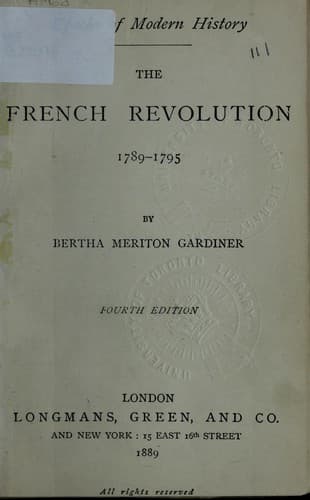
The French Revolution 1789-1795Gardiner, Bertha Meriton
History
The French Revolution 1789-1795
Gardiner, Bertha Meriton
France -- History -- Revolution, 1789-1799
Each prisoner was called in turn
before them. He was asked one or two questions, and without further
discussion, either acquitted or ordered to be taken to the other
prison, La Force, a formula which meant death. As the condemned passed
through the prison gates, executioners stationed without rained blows
upon his back and head. The street became strewn with corpses and ran
with blood.
Similar scenes were enacted at La Force, where Hébert acted as
president of the tribunal. The massacres effected in eight prisons
went on continuously for five days and nights (September 2–7),
during which it is calculated that more than a thousand prisoners
were butchered. No action was taken to interfere with the murderers.
Ministers and deputies were afraid even to denounce the Commune in
vigorous language lest the weapons of the assassins should be turned
against themselves. They had no material force on which to rely.
Santerre, who commanded the national guard, obeyed the Commune. The
inhabitants of Paris remained perfectly passive, the violence of
party strife having destroyed enthusiasm for political ideals, and
the sense of common duty. In the midst of the butchery the news came
that Verdun had fallen, and the uncertainty of their own fate deadened
men’s sympathy for the fate of those charged justly or unjustly with
being in connivance with the enemy. So far as Paris was concerned the
contrivers of the massacres succeeded in their object. The elections
to the Convention were held while terror reigned over the city, and
twenty-four men, some of whom were partners in the crime, and none of
whom were prepared to denounce it, were returned for Paris. An attempt
was made to influence, by like means, the elections in the departments.
A circular, signed by Marat and his colleagues, was sent out inviting
the country to follow the example of the capital and to murder
traitors. This incitation to massacre, was, however, attended with
small success. In a few towns murders were committed at the instigation
of agents of the Commune; but generally the elections were conducted
without disturbance.
♦The Campaign of 1792.♦
Public-domain text, read in full here on John Shaqi.
Reviews
Reviews
No reviews yet
Be the first to share your thoughts on this work.
Elsewhere in the archive
Join the Discussion
Join the discussion
Sign in to leave a comment or review.
Sign InorCreate an account