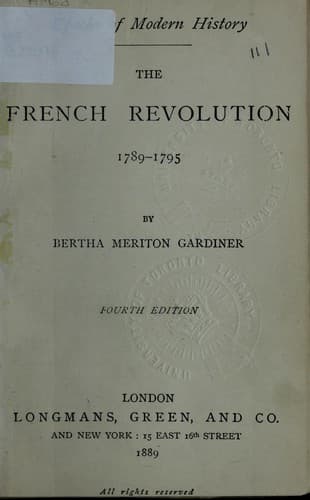
The French Revolution 1789-1795Gardiner, Bertha Meriton
History
The French Revolution 1789-1795
Gardiner, Bertha Meriton
France -- History -- Revolution, 1789-1799
The Legislative Assembly gave place to the Convention on September
21, the day after the cannonade of Valmy. At once, the abolition of
monarchy was decreed, and the following day was henceforth accounted
as the first of the French Republic. The new Assembly consisted of
749 members, of whom 186 had belonged to the legislative, 77 to the
constituent Assembly, and 486 were new men. The constitutionalists,
through intimidation or want of public spirit, had kept away from the
poll, and among all the deputies were none who did not vote for the
abolition of monarchy with real or feigned enthusiasm. The Girondists
now sat on the right, forming the conservative side of the House.
Vergniaud, Brissot, Gensonné, and Guadet were all re-elected, and
around them gathered a knot of new comers, amongst whom were Buzot,
Pétion, Barbaroux, Louvet, and others who shared their views. The
deputation of Paris, together with about thirty deputies from the
departments, now formed the Mountain, sitting as in the last Assembly
on the topmost benches of the left. Here were Marat and other directors
of the massacres, several municipal officers, including Robespierre,
Billaud-Varennes, and Collot d’Herbois, the Duke of Orleans, who to
flatter the mob now called himself Philip Egalité, Desmoulins, and
Danton, who resigned the post of minister of justice in order to retain
his seat in the Assembly.
♦The Girondists and the Mountain.♦
From the opening of the Convention irreconcilable hostility was
declared between the Girondists and the Mountain. To secure the
independence of the Convention and supremacy for their own party, the
Girondists sought to bring to justice the contrivers of the massacres,
and to destroy the ascendancy of the Commune. They resented the stain
cast on the revolution, and were eager to prove to Europe that the
massacres were the work of a few hired assassins, and not, as the
deputies of Paris strove to represent, of the people of the capital
rising spontaneously to take vengeance on traitors. In appearance
their position was strong. Through their supporters, who occupied
the ministries, they directed the government and foreign relations.
They were enthusiastic, brilliant, eloquent; they had right on their
side, and both the country and the Convention shared their abhorrence
of the crimes committed. Yet the difficulties in their way were not
to be easily overcome. The Commune ruled the capital and had in
its pay bands of thieves and assassins, whose crimes bound them to
its support. The departments had taken no part in the insurrection
of August 10, yet had accepted without question the result, and the
predominance of Paris over them had thus acquired all the strength of
uncontested fact. Public spirit, moreover, no longer existed amongst
large masses of men. Primary assemblies were nearly deserted, and few
of the many thousands whose names were inscribed as national guards
rendered active service. Under such circumstances the task of crushing
Public-domain text, read in full here on John Shaqi.
Reviews
Reviews
No reviews yet
Be the first to share your thoughts on this work.
Elsewhere in the archive
Join the Discussion
Join the discussion
Sign in to leave a comment or review.
Sign InorCreate an account