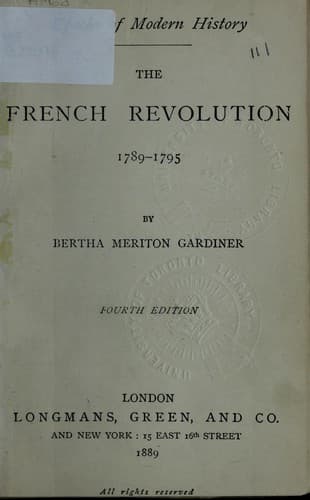
The French Revolution 1789-1795Gardiner, Bertha Meriton
History
The French Revolution 1789-1795
Gardiner, Bertha Meriton
France -- History -- Revolution, 1789-1799
the criminal band which, through the Commune and the sections, ruled
the city, was in any case difficult, and for the Girondists especially
impracticable. They were unversed in the conduct of affairs and were
strong party men, intensely credulous and suspicious in relation to all
that was outside their own circle. They stood on very narrow ground.
Republican fervour and hatred of Catholicism rendered them harsh and
intolerant towards whatever savoured of reaction. Abhorrence of crime
and pride in their own cause made them averse to compromise, and to
having dealings with men whose hands they believed to be soiled with
the blood of the September massacres. They had neither the traditions
of office nor the large capacity which creates a government by its
power of taking the lead in a distracted nation. Hence they did not
attempt to conciliate constitutionalists, nor yet to break the power
of the Commune by dividing its leaders, and bribing its followers with
money and office. As a party they did not inspire confidence. They were
without organisation or union, and being constantly divided in opinion
amongst themselves, they often voted on contrary sides. Their chief
orator, Vergniaud, possessed talent of a high order, and qualities
in which the party, as a body, was notably deficient--moderation
and foresight; but he was a man of retired habits and unassuming
disposition, who had neither taste nor inclination for the position of
a party leader. Hence the Girondists never brought forward any series
of well-concerted measures for gaining their objects, nor were they
ever able to obtain a working majority in the Convention. Impetuous
orators vaguely threatened to bring the Commune to justice, made
vehement attacks on the whole Paris deputation, and, singling out the
two most powerful men belonging to it, Robespierre and Danton, accused
them of aspiring, in conjunction with Marat, to form a triumvirate, and
Robespierre especially of aiming at a dictatorship. General charges of
this character could not be substantiated and were easily repelled.
Where, asked Robespierre, were the arms and the men by which he could
obtain a dictatorship, while he accused the Girondists of seeking to
sow disunion by calumniating Paris. It was no easy matter to fix even
on him the charge of being an author of the massacres. All members
of the Commune were, without doubt, immediately responsible for what
had taken place, but to allege mere inaction as proof of guilt was
hardly befitting to men who had formed part of the legislature at the
time Robespierre had been at the Hôtel de Ville, and had expressed
hostility towards the Girondists; but to this day it is a matter of
dispute how deeply he was implicated. Danton, though not a member of
the insurrectionary Commune, had been Minister of Justice. He, indeed,
had made no effort to stay the assassins’ hands, but there is no
proof whatever that it was he who gave the signal for the shedding of
Public-domain text, read in full here on John Shaqi.
Reviews
Reviews
No reviews yet
Be the first to share your thoughts on this work.
Elsewhere in the archive
Join the Discussion
Join the discussion
Sign in to leave a comment or review.
Sign InorCreate an account