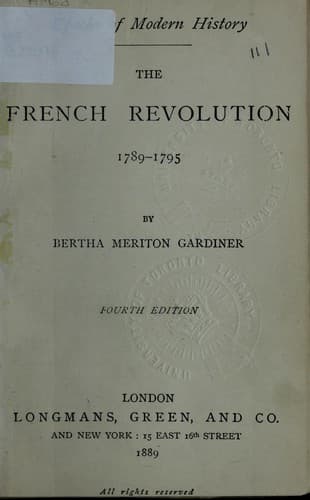
The French Revolution 1789-1795Gardiner, Bertha Meriton
History
The French Revolution 1789-1795
Gardiner, Bertha Meriton
France -- History -- Revolution, 1789-1799
were in occupation of Belgium, the Convention had proclaimed the free
navigation of the Scheldt, which by an European arrangement, agreeable
to England and Holland, but ruinous to the trade of Antwerp, was closed
to commerce. This measure gave great offence to England as increasing
French influence, and was regarded in itself as sufficient ground for
a declaration of war. Though in accordance with the new principles
of the rights of nations not recognised by cabinets, but which were
no more than the principles of justice itself, the liberation of the
Scheldt was in the teeth of treaties to which both England and France
had been parties. The decree of November 19 (p. 131), which the French
government refused to withdraw, was regarded as a direct incitation to
subjects to revolt. The passing of a new decree (December 15), ordering
French generals to proclaim wherever they went the sovereignty of the
people, the suppression of the existing authorities, and the abolition
of feudal rights and privileges, was a second clear intimation to
Europe that France was intent on spreading revolutionary principles
beyond her own borders.
A portion of the Convention desired, at whatever hazard, to carry out
an immediate annexation of Belgium, and afterwards to invade Holland,
in accordance with a plan proposed by Dumouriez. Holland was at peace
with France, but there was no doubt whatever that in case of war
between England and France, the stadt-holder, who was maintained in
his seat by English and Prussian influence, would join the coalition.
The majority, however, led by the Girondists, hesitated to adopt
this course. Although their minds were inflated with the desire of
rousing revolutionary movements in other countries, including England
itself, they sought, from a sense of internal peril which every day
grew stronger, to circumscribe the field of war, and both to maintain
peace with England and to withdraw Prussia from the coalition. To
attain their ends the ministers were prepared to abandon the project
of invading Holland, to suffer the King and his family to quit France,
and to defer the final settlement of Belgium till the making of peace.
But neither the disposition of the King of Prussia nor of the English
people rendered it possible for any understanding to be arrived at on
these terms.
♦Austria and Prussia unwilling to make peace.♦
Public-domain text, read in full here on John Shaqi.
Reviews
Reviews
No reviews yet
Be the first to share your thoughts on this work.
Elsewhere in the archive
Join the Discussion
Join the discussion
Sign in to leave a comment or review.
Sign InorCreate an account