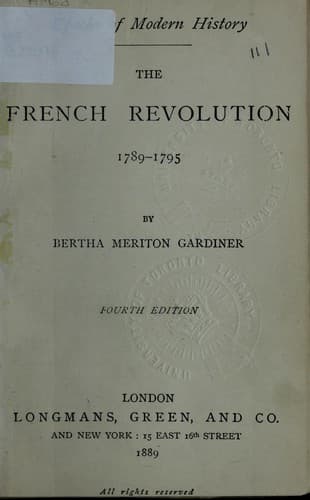
The French Revolution 1789-1795Gardiner, Bertha Meriton
History
The French Revolution 1789-1795
Gardiner, Bertha Meriton
France -- History -- Revolution, 1789-1799
The allied princes had not entered into the war out of pure chivalry,
and did not intend to withdraw from it until they had obtained what
in diplomatic language they called an indemnity--in other words,
territorial acquisitions, either at the cost of France or of some
neutral state. Shortly before hostilities broke out Catherine II.
proposed to Frederick William a second partition of Poland. The King,
though bound by two treaties to maintain the integrity of Poland,
entered into the agreement. It was, therefore, to Poland that he looked
for his indemnity, and his assistance in the war against France was
the price he paid for the Emperor’s consent to his making acquisitions
in the east. Francis, on his side, looked for conquests in France,
and also had in his mind the revival of Joseph’s project of making
over Belgium to the Elector of Bavaria in exchange for that country.
A study of the map of Europe shows clearly what would have been the
advantage of the exchange to Austria in consolidating her dominions and
giving her increased predominance within the Empire.
♦England and the revolution.♦
While the personal feeling of Frederick William involved his subjects
in a war for which they had no enthusiasm, public opinion in England
compelled the Government to take a hostile attitude. William Pitt,
supported by the King, the country gentlemen, and the commercial middle
classes, had fought his way to power in 1783 in a sharp struggle in
which the Whig aristocracy was overthrown. As the head of the Tory
party he professed a toryism very different from the past toryism
of Harley and of St. John, which had battled against dissenters and
the mercantile class, and from the future toryism of Eldon, which
was to battle against improvement. In one sense he was the Turgot of
England. He was pre-eminently a peace minister, and he had taken the
lead, sometimes far in advance of the public opinion of his day, in
advocating projects of financial and economical reform. Those projects
he had viewed from the point of view of the highest statesmanship. He
had sought to bind England and Ireland together by a commercial union,
which he was unable to carry into effect. He had sought to bind England
and France together by a commercial treaty which had increased the
communications between the two countries. It was not his fault that
even a Parliament in which he counted so many supporters had rejected
a scheme of Parliamentary reform, which would have gone far to bind
class to class in England itself. Yet, even in his failures, his
efforts after good had made his government inapproachably strong. The
fallen Whig aristocracy, indeed, was very different from the effete
privileged orders of France. It counted amongst its members and its
followers high-spirited and large-minded politicians, such as Fox and
Burke. Its traditions were those of men brought up to combat for their
ideas in the open light of publicity, and to support their cause by
argument before their fellows.
Public-domain text, read in full here on John Shaqi.
Reviews
Reviews
No reviews yet
Be the first to share your thoughts on this work.
Elsewhere in the archive
Join the Discussion
Join the discussion
Sign in to leave a comment or review.
Sign InorCreate an account