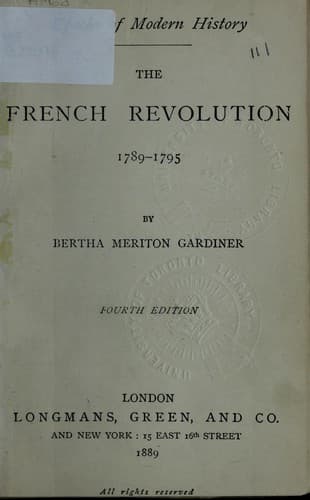
The French Revolution 1789-1795Gardiner, Bertha Meriton
History
The French Revolution 1789-1795
Gardiner, Bertha Meriton
France -- History -- Revolution, 1789-1799
Yet there was something in it of the
faults which had made the continental nobilities unpopular. It was
narrow and exclusive, and was apt to regard office and emolument as
the special perquisite of its own members. Against such an aristocracy
Pitt stood as the champion of so much of equality as the conditions
of English society admitted of. Representing, as he did, the King and
the middle classes, he advocated a rational government, founded on
the best political science of the day. It was impossible that if war
broke out with France he should continue his work of internal reform.
Events happening in France were but superficially comprehended in
England. At first some of the Whigs, following Fox, extended sympathy
to a revolutionary movement which put forward as its object the
establishment of constitutional government. As soon as disorder and
violence showed themselves in France a large section of the Whigs,
including most of the great landowners, joined the Tories in viewing
the movement with distrust, though the latter had confidence in Pitt,
who sought to maintain friendship between the two governments. Neither
party had any clear perception of the fact that the revolution was
produced by social as well as political causes, and that its real aim
was to complete the destruction of the old feudal order long since in
slow process of decay. The special causes of discontent operating in
France were left unnoted. The comparative excellence of government in
England made Englishmen callous to the past misgovernment of France.
The fact was patent that the revolution declared war on established
institutions, and exhibited propagandist tendencies. Public opinion,
therefore, soon set strongly against it. Already, in 1790, Burke,
breaking loose from Fox, published his ‘Reflections on the French
Revolution,’ in which his eloquent declamations against men who were
destroying continuity between the past and the present, helped to
ripen the distrust that already existed in the minds of his countrymen
into fear and hatred. After the fall of the throne and the September
massacres, intense alarm prevailed lest the spread of democratic
principles should produce similar convulsions in England. In reality
there was no danger. The middle classes were not jealous of the upper;
the people were not starving. Societies established for the promotion
of French principles obtained but a few hundred supporters, a strong
proof of the unmoved disposition of the people at large. The panic,
however, if unfounded, was genuine. To secure themselves against danger
the governing classes desired to suppress the revolution by force
of arms, and loudly demanded the reclosing of the Scheldt and the
evacuation of Belgium as the price of peace.
Public-domain text, read in full here on John Shaqi.
Reviews
Reviews
No reviews yet
Be the first to share your thoughts on this work.
Elsewhere in the archive
Join the Discussion
Join the discussion
Sign in to leave a comment or review.
Sign InorCreate an account