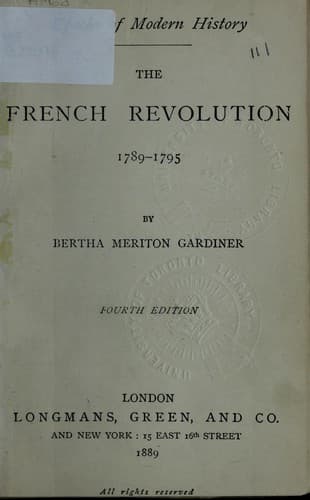
The French Revolution 1789-1795Gardiner, Bertha Meriton
History
The French Revolution 1789-1795
Gardiner, Bertha Meriton
France -- History -- Revolution, 1789-1799
As the situation grew more perilous, legislation assumed an
increasingly harsh and tyrannical character. In March, at the very time
when the retreat of Dumouriez from Belgium offered an opportunity to
the allies of attempting a march on Paris, a dangerous insurrection,
excited by the forced recruitment, broke out amongst the peasants
of La Vendée. The Convention, enraged against its adversaries, and
frightened at the unexpected danger, struck at random, regardless of
the fact that it was crushing the innocent along with the guilty. Those
who instigated resistance to the recruitment of the army were punished
by death. Priests, subject to banishment, who had remained in the
country, were to be transported to French Guiana. Banished priests who
returned were to be executed within twenty-four hours. The Legislative
Assembly had made it a crime to quit the country, and had confiscated
the property of the emigrants. The Convention laid a firmer grip on
their property by banishing them for ever from the republic, and by
forbidding them to return under penalty of death. Although many of the
exiles had had no intention of fighting against their country, but had
merely quitted France because their lives were in danger, no exceptions
were made, and no account taken of sex or circumstance.
♦Policy of the Mountain.♦
In the midst of internal strife and preparation for defence the
Convention was engaged on the task of framing a new constitution. When
abstract questions were under discussion but little difference of
view arose. In fact, the contention between the two parties did not
concern principles, but their immediate application. The Girondists
were prepared, without heed of circumstances, to carry into action
principles of decentralisation, popular election, and free trade, and
contended that the republic must rest upon the political virtue and
public spirit of the mass of the population. The Montagnards regarded
facts only. They recognised that active support to the republic was to
be looked for from the mob alone; that attempts to enforce principles
of free trade against the will of their own supporters must lead to
the overthrow of the Convention; that under the circumstances popular
election was a farce, and that amid the strife of parties and factions
decentralisation meant, as the experience of the past two years had
shown, that France would be without an effective Government at a time
when a powerful coalition was formed against her. A far lower motive
impelled them in the same direction. The safety of their country
appeared to them dependent on the triumph of their own party, and to
secure this they were prepared to act in the teeth of their theoretical
opinions. They denied liberty to the press. They sacrificed freedom
of trade to the clamours of the populace. They not only maintained
the right of Paris to act for the whole of France, but, in order the
more effectually to secure submission, sought by the agency of clubs
Public-domain text, read in full here on John Shaqi.
Reviews
Reviews
No reviews yet
Be the first to share your thoughts on this work.
Elsewhere in the archive
Join the Discussion
Join the discussion
Sign in to leave a comment or review.
Sign InorCreate an account