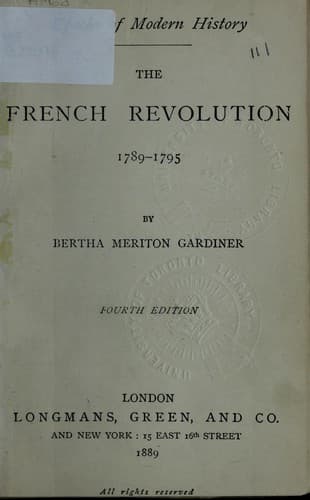
The French Revolution 1789-1795Gardiner, Bertha Meriton
History
The French Revolution 1789-1795
Gardiner, Bertha Meriton
France -- History -- Revolution, 1789-1799
and special committees to stamp out all vestiges of public spirit that
yet remained in the departments, and were indifferent to the character
of their instruments, or to the commission of acts of injustice and
cruelty, so long as their own ascendancy was secured.
♦Economical situation.♦
The Girondists denounced the policy of their adversaries with eloquence
and fervent indignation. But the issue of the struggle was dependent,
not on their power of speech, but on the support which they could
obtain in Paris. Affection for the Convention was nowhere to be found.
The middle classes were alienated by the death of the King, the lower
classes by the dearness of food, while large numbers were estranged
by the indifference manifested by the Convention towards the Catholic
faith. The actual hostility of the working classes was excited in
consequence of the strenuous opposition made by the Girondists to the
economic theories which found favour in the streets. In July 1792, the
nominal value of assignats in circulation was about 87,500,000_l._
In May 1793, it had risen, owing to the war expenditure, to about
131,250,000_l._ The Church lands, the security on which the assignats
were first issued, were already sold. A new security had been found in
the property of emigrants, which was now in course of sale. This was
conveniently estimated to be worth the exact amount of the assignats
in circulation, 131,250,000_l._ The Government, however, remained no
better off. It had no credit on which to borrow, and taxes were only
partially paid. All foresaw that, to cover the war expenses, it would
be necessary to have recourse to new issues of assignats, and hence in
spite of the large security offered the paper money fell rapidly in
value. In March 1793, assignats could be exchanged for silver at about
half their nominal value. To supply the deficiency of small change the
Legislative Assembly had created notes for very small sums. Hence the
depreciation of the paper money inflicted great suffering on men living
on wages, who had nothing but these small notes on their hands. Since
the autumn of 1791 prices had been rising rapidly all over France,
while special causes contributed to produce dearness and scarcity of
food in Paris. In proportion as assignats were multiplied all persons
disliked to hold them. While purchasers were eager to pay with them,
sellers pressed for coin in exchange for their wares. The consequence
was that trade deserted Paris, where paper money was most abundant,
and where it was more difficult to get payment in gold and silver
than in the country. Corn-growers kept their corn in store or sent it
elsewhere. Few cattle came to market. Bread, meat, fish, wine, wood--in
short, all articles rose in price, some trebling in cost in the course
of six months. In the spring of 1793 the drawing off of men to the
frontier caused a rapid rise in wages, which before had not advanced
in proportion to prices. Nevertheless, real want existed amongst the
Public-domain text, read in full here on John Shaqi.
Reviews
Reviews
No reviews yet
Be the first to share your thoughts on this work.
Elsewhere in the archive
Join the Discussion
Join the discussion
Sign in to leave a comment or review.
Sign InorCreate an account