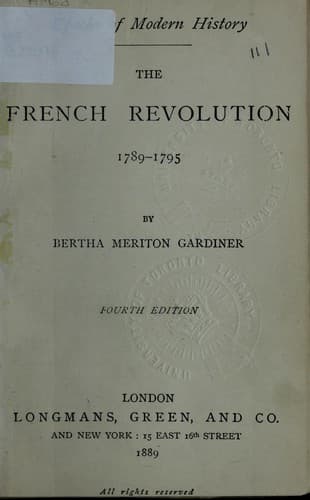
The French Revolution 1789-1795Gardiner, Bertha Meriton
History
The French Revolution 1789-1795
Gardiner, Bertha Meriton
France -- History -- Revolution, 1789-1799
There was one in every section of Paris, and ultimately in
most municipalities in the country. These committees, which usurped
the functions of the ordinary or civil committees of the sections,
became agents for the execution of the police laws generally, and
soon acquired celebrity under the name of revolutionary committees.
Nobles and ecclesiastics were excluded from sitting on them, and they
were most often composed of ruffianly and dissolute adventurers.
One insurrectionary committee was now formed at Paris of delegates
from these revolutionary committees; a second of delegates from the
sections. The Commune, under the leadership of its mayor, Pache, and
its two law officers, Hébert and Chaumette, set itself at the head of
the movement. Some Montagnards, including Robespierre, Marat, Collot
d’Herbois, Chabot, Tallien, and Desmoulins gave it undisguised support.
But those whose hostility was less, hesitated. For if the Mountain had
to call in the aid of the Commune in order to obtain victory over the
Girondists, what security was there that after their expulsion it would
be able to maintain its own independence? And what influence could
Danton hope to exercise over a brow-beaten and intimidated body of men,
in fear for their lives? Compromise with the Girondists was, however,
impracticable, and the Committee of Public Safety, in place of taking
active measures against the conspirators, sought merely to moderate
their violence.
♦June 23.♦
While their enemies plotted the Girondists made no efforts to secure
the Convention against attack, or to form a party in Paris for its
defence. They relied on their eloquence and the goodness of their cause
to keep the centre true to them. They made the useless proposition that
the primary assemblies should meet and decide which deputies should
be ejected, and which keep their seats. They obtained addresses from
the departments promising armed intervention in their support, and in
case of insurrection threatened Paris with annihilation. ‘If ever,’
said the unrestrainable Isnard, when President of the Convention, to
a deputation from the Commune, ‘it should happen that violence were
offered to the national representatives, I declare to you, in the name
of the whole of France, that Paris would be destroyed, and grass would
grow on the banks of the Seine.’ Such words were far more hurtful to
the Girondists themselves than to those whom they threatened. They
sounded in men’s ears like an echo of Brunswick’s proclamation, and
made the inhabitants of Paris fear more the consequences of the success
of the Girondists, in case of a collision between the two parties, than
those of submission to the one which posed itself as the defender of
Paris from violence. Meanwhile the enemies of the Girondists lost no
opportunity of turning opinion against them. They accused them, not
only of seeking to excite civil war, but also of being Federalists,
and of plotting to destroy the unity of the republic by making the
Public-domain text, read in full here on John Shaqi.
Reviews
Reviews
No reviews yet
Be the first to share your thoughts on this work.
Elsewhere in the archive
Join the Discussion
Join the discussion
Sign in to leave a comment or review.
Sign InorCreate an account