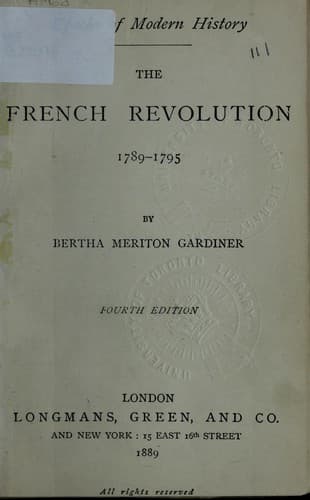
The French Revolution 1789-1795Gardiner, Bertha Meriton
History
The French Revolution 1789-1795
Gardiner, Bertha Meriton
France -- History -- Revolution, 1789-1799
departments independent of the capital. Marat and his murderous
followers were ready to execute a second massacre, whilst amongst the
people propositions were heard for a redistribution of property. Such
ideas were not countenanced either by the Jacobins or the Commune.
Bloodshed might lead the departments to rise, and it was possible
that the middle classes in Paris might move for the defence of the
Girondists if they thought the city was to be given over to assassins
and assailants of the rights of property. Meanwhile the Convention,
encouraged by some movements in the sections against the tyranny of
the Commune, assumed a bolder attitude, and appointed a commission of
twelve deputies to investigate the conspiracies (May 18). Hébert and
other agitators were arrested. But these acts of vigour hastened the
crisis. To quiet the apprehensions of the middle classes the Commune
and the Jacobins made public declaration of their respect for property
and of their intention to maintain order.
The Convention a few days previously had removed from the Riding School
to a spacious hall in the Palace of the Tuileries, capable of holding
more than a thousand persons. On May 31 armed bands streamed through
the streets to impose their will on the representatives of the nation.
The terrorised Convention decreed the suppression of the Commission of
Twelve, but refused to proscribe its members. It was not allowed to
escape without bending its neck yet more beneath the yoke. On June 2
many thousand insurgents flooded the Chamber, demanding, with threats,
the arrest of the leaders of the right. The alarmed and indignant
deputies, with the exception of some thirty on the left rose in a body
and left the hall. But all issues out of the palace courts and garden
were closely guarded, and passage refused with insult. They returned,
and while intruders sat on the benches and voted with them, a decree
was carried that thirty-one deputies, including Vergniaud, Gensonné,
Guadet, Brissot, and other leading Girondists, should be kept under
arrest at their own houses.
CHAPTER VII
THE COMMUNE AND THE TERROR.
Public-domain text, read in full here on John Shaqi.
Reviews
Reviews
No reviews yet
Be the first to share your thoughts on this work.
Elsewhere in the archive
Join the Discussion
Join the discussion
Sign in to leave a comment or review.
Sign InorCreate an account