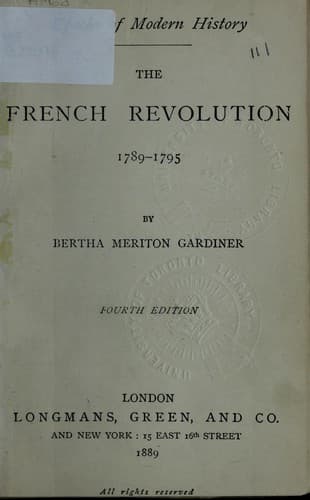
The French Revolution 1789-1795Gardiner, Bertha Meriton
History
The French Revolution 1789-1795
Gardiner, Bertha Meriton
France -- History -- Revolution, 1789-1799
By the side of the Committee of Public Safety, the Commune of Paris
occupied an independent position. Although nominally merely the body
administering the affairs of the capital, it in reality took the lead
in directing the general affairs of France. After it had accomplished
the insurrection against the Girondists, it was the strongest power
in Paris. It had armed bands of ruffians in its pay; the national
guard was under its orders; the revolutionary and civil committees of
the sections were its tools; and, for the time, it had the support of
the populace, which it supplied with bread. The Committee of Public
Safety dared as little as the Mountain risk collision with it. It
forced its supporters into the government offices; sent agents into the
departments; exerted influence over deputies in mission, and compelled
the Convention to appoint ministers and generals of its selection, and
to make laws in accordance with its wishes.
The action of the Commune had for long been mainly directed by two men,
Chaumette and Hébert. They had both been members of the insurrectionary
Commune which had driven Louis from the Tuileries in 1792, and after
its re-election had been ordered by the Convention in the autumn of
the same year, they had reappeared at the Hôtel de Ville, where they
filled the influential position of law officers to the new Commune,
which was made up in part of the same men, and was animated by the
same spirit as its predecessor. Their ascendancy was now signalised
by an extraordinary outburst of cruelty and fanaticism. Not content
with the abolition of political and civil distinctions between man and
man, they sought to destroy all superiorities and to put men socially
and intellectually on the same level. The superiority of wealth was
a special object of their attack. Capitalists, bankers, speculators,
large landowners, were by them and their followers classed along with
federalists, Girondists, nobles, priests, and royalists, as enemies to
the republic. Intellectual superiority and culture became a crime in
their possessors. Equality, in short, was to be produced not by the
raising of the lower, but by the degradation of the higher. If Hébert
demanded the establishment of a primary school in every village, he was
actuated not so much by a regard for the moral and intellectual results
of education as by the wish to make the working classes independent of
the upper. Higher education, more especially classical education, was
decried. Valuable books, statues, and works of art which bore trace
of having been produced under the monarchy, were wantonly destroyed.
Ignorance and rags were put forward as in themselves giving a claim to
respect, and the term ‘sans-culotte,’ ‘the breechless’ (applied to the
poor from their wearing trowsers in place of knee-breeches), was held
synonymous with that of ‘patriot.’ The words ‘Monsieur’ and ‘Madame’
were replaced by ‘citoyen’ and ‘citoyenne,’ and an untidy dress, a
Public-domain text, read in full here on John Shaqi.
Reviews
Reviews
No reviews yet
Be the first to share your thoughts on this work.
Elsewhere in the archive
Join the Discussion
Join the discussion
Sign in to leave a comment or review.
Sign InorCreate an account