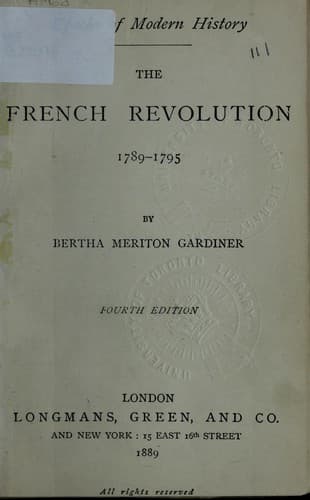
The French Revolution 1789-1795Gardiner, Bertha Meriton
History
The French Revolution 1789-1795
Gardiner, Bertha Meriton
France -- History -- Revolution, 1789-1799
rough manner, and rude language were adopted as symbols of a patriotic
spirit.
Despite the violence and brutality of which they were guilty, neither
the leaders of the Commune, nor yet many of those who followed in
their track or spurred them on, were without enlightened ideas. The
humane philosophy of the century had left its impression, though
it might be but a superficial one, on the hardest and most selfish
natures. Thus, while they sought by terror to destroy the existing
bases of society, Chaumette and Hébert sought also to figure in the
light of philanthropists and guardians of public morality. Acting under
their impulse, the Commune brought forward projects for the reform of
youthful criminals, and for the alleviation of the sufferings of the
sick in hospitals, as well as others of like character, and incessantly
urged on the Convention the suppression of state lotteries, by which
the poor were led to gamble away their sous. Even at their best,
however, the members of the Commune were mainly actuated by personal
motives. They sought to obtain some moral support to their position,
without which it would in the end be impossible for them to retain
power for long. Of their philanthropic schemes, moreover, very few
were carried out in practice. It was the inevitable result of the
conditions under which the Commune had grasped authority, that the
better men should be thrust into the background by the more selfish
and more unscrupulous. Thus Chaumette by the side of Hébert soon sank
into comparative insignificance. For while Chaumette cared for the
accomplishment of ideal aims, Hébert cared alone for the retention
of power by himself, and was entirely indifferent as to the means by
which he secured this end. He was a coarse and low-minded adventurer.
Before the revolution he had been dismissed from an inferior office at
a theatre for dishonest practices. After the revolution began, he had
sought notoriety by the publication of a paper, _Le Père Duchesne_,
written in language coarse even for that time, and advocating atheism.
Around him and the Commune now rallied all the worst ruffians and
scoundrels in Paris. Assassins were appointed to the command of armed
forces, and thieves and rogues were placed on civil and revolutionary
committees which had at their disposition the property and liberty
of their fellow-citizens. In short, so far as the administration was
concerned, the prevailing characteristics of the rule of the Commune
under Hébert’s leadership were anarchy and licence.
♦The Conscription.♦
Public-domain text, read in full here on John Shaqi.
Reviews
Reviews
No reviews yet
Be the first to share your thoughts on this work.
Elsewhere in the archive
Join the Discussion
Join the discussion
Sign in to leave a comment or review.
Sign InorCreate an account