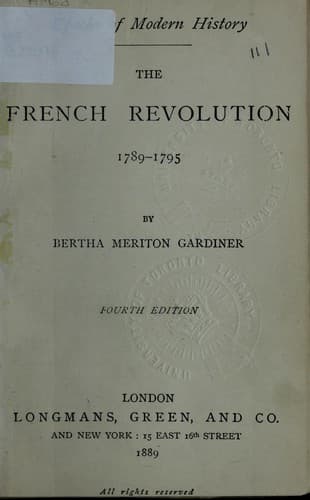
The French Revolution 1789-1795Gardiner, Bertha Meriton
History
The French Revolution 1789-1795
Gardiner, Bertha Meriton
France -- History -- Revolution, 1789-1799
May 20. (Prairial 1) Second insurrection by Lower Classes against
the Convention.
April 5. _Treaty of Peace made at Basel between France and Prussia._
June 8. Death of the Dauphin.
July 12. _Treaty of Peace between France and Spain._
July 21. _Defeat of Emigrants at Quiberon._
Sept. 23. Proclamation of the Constitution of the Year III. (1795).
Oct. 5. (Vendémiaire 13) Insurrection of the Middle Classes
against the Convention.
Oct. 26. (Brumaire 4) Meeting of the New Legislature.
THE FRENCH REVOLUTION.
CHAPTER I.
FEUDALISM AND THE MONARCHY.
♦The Monarchy in France.♦
Like the rest of Western Europe, France, in the Middle Ages, was ruled
by a feudal nobility, holding their lands of the king. Nowhere in
Western Europe in the tenth century was the power of the king less,
or the power of the nobles greater. The weight of their authority,
therefore, fell heavily upon the peasants on their estates, and upon
the inhabitants of the little towns scattered over the country. A
feudal noble, if he were a _seigneur_, answering to our lord of the
manor, ruled all dwellers on his estate. Their claims to property
were heard in his courts, and they were amenable to his jurisdiction
for crimes committed, or alleged to have been committed, by them. The
seigneur may not have been a worse tyrant than many kings and princes
of whom we read in history; but he was always close at hand, whilst
Nero or Ivan the Terrible was far off from the mass of his subjects.
He knew all his subjects by sight, had his own passions to gratify
amongst them, and his vengeance to wreak upon those whom he personally
disliked. To be free from this domination must have been the one
thought of thousands of miserable wretches.
To shake off the yoke by their own efforts was an impossibility. The
nearest ally on whom they could count was the king. He too was opposed
to the domination of the nobles, for as long as they could disregard
his orders with impunity, he was king in name alone. He was, in fact,
but one nobleman amongst many, with a higher title than the rest.
Public-domain text, read in full here on John Shaqi.
Reviews
Reviews
No reviews yet
Be the first to share your thoughts on this work.
Join the Discussion
Join the discussion
Sign in to leave a comment or review.
Sign InorCreate an account