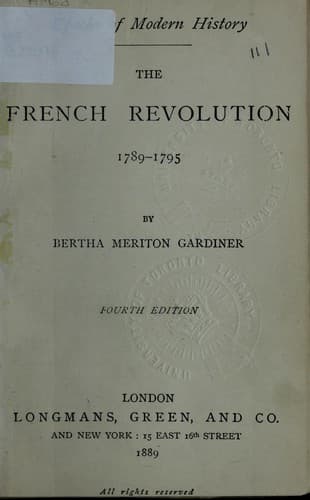
The French Revolution 1789-1795Gardiner, Bertha Meriton
History
The French Revolution 1789-1795
Gardiner, Bertha Meriton
France -- History -- Revolution, 1789-1799
From a variety of motives all who could pressed into the service of the
State. It was the one means of avoiding the proscription, the surest
means of avoiding imprisonment, the surest means of acquiring wealth.
The Government offices were flooded with incapable clerks. Municipal
officers and administrators, charged with the care and sale of national
property, had abundant opportunities of benefiting themselves and their
relatives at the expense of the State. The multitude of agents who
were employed in making requisitions for the army could, with small
danger of exposure, enrich themselves by extortion and by breach of the
maximum laws.
♦Formation of a revolutionary army.♦
The maximum laws prevented prices from rising in the open market,
but they could not assure abundance. It was possible to search a
tradesman’s cellars, and to force him to offer his existing stock of
goods for sale at a definite price; but it was impossible to make him
continue to carry on his trade at a loss to himself. It was easier
for the farmer than for the tradesman to break the law; but this did
not benefit the inhabitants of towns. The farmer would often choose
to risk his head by concealing his corn or by sending it out of the
country, sooner than send it to Paris or any other large town, where
the maximum law was most rigidly enforced, and its breach attended
with greatest danger to himself. Since the spring the Commune had
been compelled to take upon itself the entire task of providing for
the city’s consumption of bread. Its agents went into the surrounding
departments and purchased all the corn and meal they could obtain,
often giving a higher price than that prescribed by the law; but it was
nevertheless only with extreme difficulty that the necessary provision
was made. In order to maintain popularity with the working classes,
the Commune was, however, compelled to provide that the daily supply
of bread did not fail. It was compelled also to give satisfaction to
that idle and ruffianly portion of the population by aid of which it
was enabled to impose its will upon the Convention and the Committee
of Public Safety. At the demand of the Commune the Convention passed
a law declaring that Paris, like the armies, should be supplied by
requisitions, and ordering the formation of a special paid force, or
so-called ‘revolutionary army,’ of 7,000 men, which was to go into the
departments and compel farmers to part with their corn at the maximum
price. By these means the Commune obtained command of a new force, and
found means of living for the destitute thieves and beggars with whom
the city swarmed. This army was simply a horde of villains, let loose
upon the neighbouring departments, who went from village to village,
plundering, imprisoning, and torturing the inhabitants. Meanwhile,
scarcity increased at Paris to such an extent that to put an end to the
crowding at the bakers’ doors, the Commune ordered that tickets should
Public-domain text, read in full here on John Shaqi.
Reviews
Reviews
No reviews yet
Be the first to share your thoughts on this work.
Elsewhere in the archive
Join the Discussion
Join the discussion
Sign in to leave a comment or review.
Sign InorCreate an account