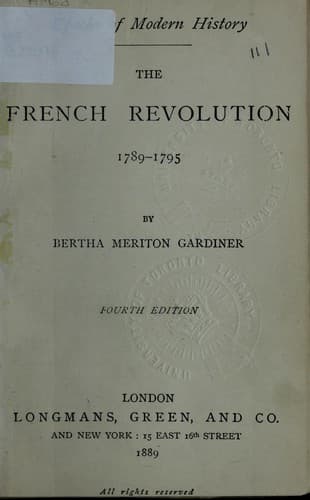
The French Revolution 1789-1795Gardiner, Bertha Meriton
History
The French Revolution 1789-1795
Gardiner, Bertha Meriton
France -- History -- Revolution, 1789-1799
service of the armies, were put in requisition, which meant that their
owners were compelled to sell to the Government at the maximum price,
and to take in payment assignats at their nominal value. Exactly the
same course was pursued with regard to labour. A maximum was fixed for
wages, the most the workman might demand being the wage he received in
1790, with the addition of half as much again. Workmen, like goods,
were then put in requisition, and employed by thousands in making of
arms, building of ships, repairing of roads, and other services of
the same character. In every transaction the State thus gained at the
expense of individuals, since the assignats, in which all payments were
made, were now worth only 33 per cent. of their nominal value.
Together with the requisition and maximum laws were passed others,
which had for their direct object the suppression of speculation on the
fluctuation in prices and in the value of the paper money. Capitalists,
bankers, merchants engaged in foreign commerce, and speculators of
every description, were denounced as aristocrats and enemies of
their country, and in order the more effectually to suppress their
transactions, the idea was entertained of breaking off commercial
and financial relations between France and foreign countries. It
was rendered a capital offence to refuse to accept assignats in
payment of goods, or to offer or accept a higher price in them than
in metal money. Financial and commercial companies were dissolved.
The investment of capital in foreign countries was prohibited, the
Exchange closed, the export of nearly all articles of French growth
and manufacture forbidden, and the mere possession of articles grown
or manufactured in Great Britain declared a crime. All the laws here
described were enforced by fines, confiscations, the prison, and the
guillotine. They succeeded in their immediate end. Wherever buying
and selling went on in public the paper money was taken at par, and
the Government was able to go on incessantly increasing the number of
notes in circulation without meeting a corresponding rise in prices.
But this result was only obtained at the cost of the destruction of
private enterprise, the ruin of hundreds of traders and manufacturers,
a lavish waste of the capital of the country, and the infliction of
an enormous amount of suffering. Little foreign trade remained except
what the Government itself carried on, and the only manufactures which
flourished were those of arms and war material. Trade and agriculture
became the most dangerous occupations in which it was possible to
engage.
Public-domain text, read in full here on John Shaqi.
Reviews
Reviews
No reviews yet
Be the first to share your thoughts on this work.
Elsewhere in the archive
Join the Discussion
Join the discussion
Sign in to leave a comment or review.
Sign InorCreate an account